- English
- French
- German
- Portuguese
- Spanish
- Russian
- Japanese
- Korean
- Arabic
- Irish
- Greek
- Turkish
- Italian
- Danish
- Romanian
- Indonesian
- Czech
- Afrikaans
- Swedish
- Polish
- Basque
- Catalan
- Esperanto
- Hindi
- Lao
- Albanian
- Amharic
- Armenian
- Azerbaijani
- Belarusian
- Bengali
- Bosnian
- Bulgarian
- Cebuano
- Chichewa
- Corsican
- Croatian
- Dutch
- Estonian
- Filipino
- Finnish
- Frisian
- Galician
- Georgian
- Gujarati
- Haitian
- Hausa
- Hawaiian
- Hebrew
- Hmong
- Hungarian
- Icelandic
- Igbo
- Javanese
- Kannada
- Kazakh
- Khmer
- Kurdish
- Kyrgyz
- Latin
- Latvian
- Lithuanian
- Luxembou..
- Macedonian
- Malagasy
- Malay
- Malayalam
- Maltese
- Maori
- Marathi
- Mongolian
- Burmese
- Nepali
- Norwegian
- Pashto
- Persian
- Punjabi
- Serbian
- Sesotho
- Sinhala
- Slovak
- Slovenian
- Somali
- Samoan
- Scots Gaelic
- Shona
- Sindhi
- Sundanese
- Swahili
- Tajik
- Tamil
- Telugu
- Thai
- Ukrainian
- Urdu
- Uzbek
- Vietnamese
- Welsh
- Xhosa
- Yiddish
- Yoruba
- Zulu
Why tall building crews run a floor deck roll forming machine on site
Tall building crews increasingly run a floor deck roll forming machine directly on the job site because it cuts lead times, reduces transport damage, and gives structural teams full control over profile dimensions. Instead of waiting on offsite fabricators, a composite deck forming line converts galvanized or Galvalume coils into finished B-deck or 1.5-inch rib profiles right where the concrete pour happens. That immediate production loop is changing how high-rise steel frames get built across the United States.
Challenges in Traditional Floor Deck Fabrication for Tall Buildings
The industry is plagued by a number of significant challenges, and the severity of these problems increases in tandem with the size of the structures and the stringency of the deadlines. In spite of the fact that the sector has been using manufacturing that is located offshore for a considerable amount of time, it is still struggling with these difficulties. Additionally, the industry is still struggling with similar issues to this day.
Supply Chain Delays Hit Hard on High-Rise Schedules
Every four to seven days, a 40-story building pours a new floor. An entire iron crew can be put on hold if there is a problem with the shipping of deck panels from a faraway plant. The Steel Deck Institute (SDI, 2022) says that delays in delivering materials cause almost 18% of structural steel scheduling overruns on high-rise projects in cities.
Transportation Damage Raises Material Waste Costs
Although long-span composite deck profiles are stiff, they can get edge crimping and galvanized coating wear during flatbed transport. Panels that are damaged often need to be cut in the field or completely replaced, which adds to the cost of both work and zinc-coating repair. The mechanical bond between the embossed steel and the concrete poured on top of it can be broken by even small surface damage.
Inflexible Supply Chains Block Quick Design Changes
Late in the planning process, structural engineers often change the depth of ribs or the width of panels. When fabrication is done off-site, every change means a new order, a longer lead time, and higher freight costs. Site crews have to deal with panels that don't match up with the latest plans, which makes it harder for ironworkers to do their jobs and for quality inspectors to do their jobs.
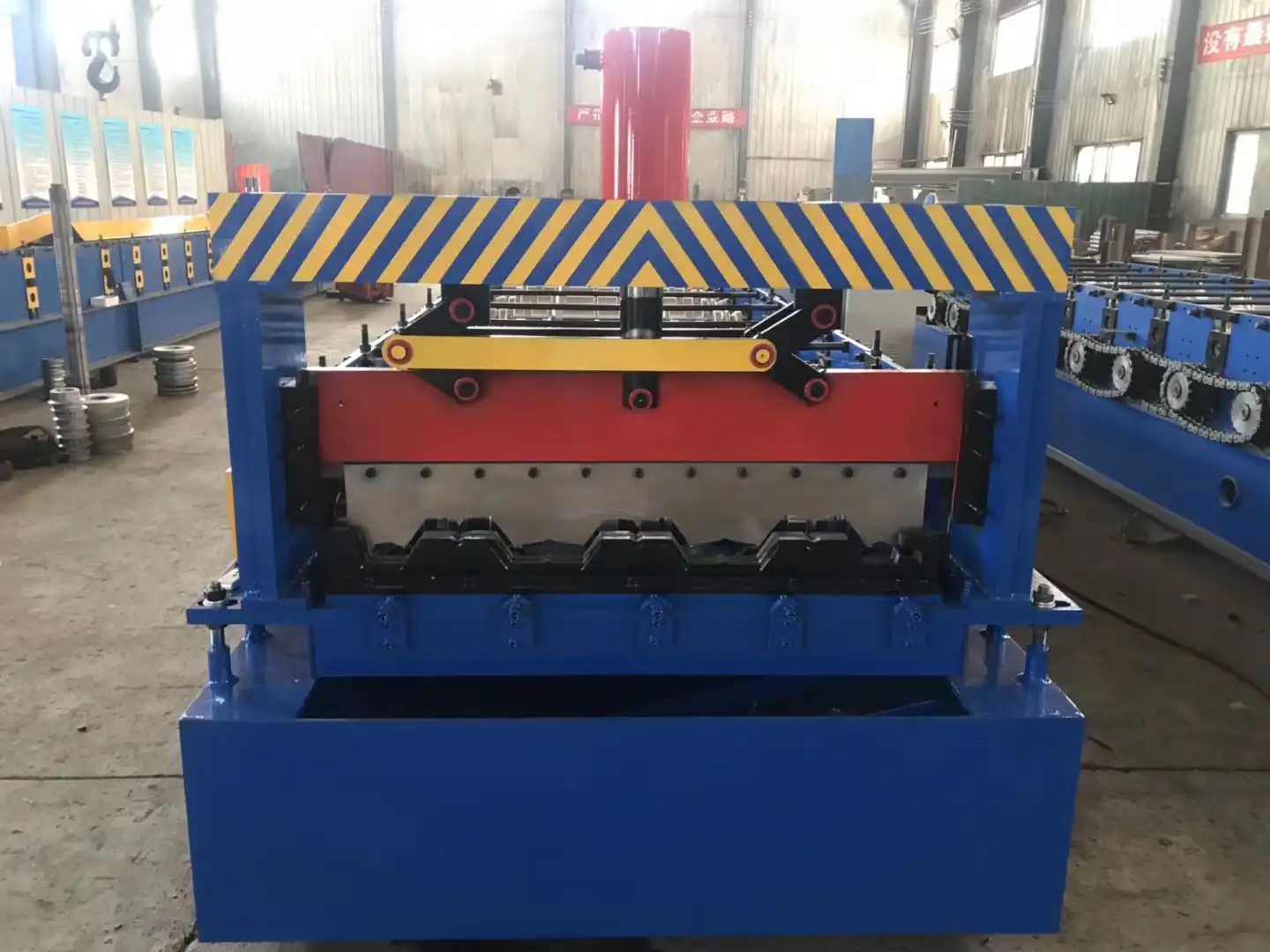
How a Metal Deck Roll Forming Line Transforms Onsite Production
The workers who are working in the construction sector have succeeded in transforming the construction floor into a tiny factory as a result of the implementation of the forming line on the building site. The eradication of each and every one of the friction regions that were mentioned earlier in the phrase has been brought about as a consequence of this.
Continuous Cold Forming Directly From Coil
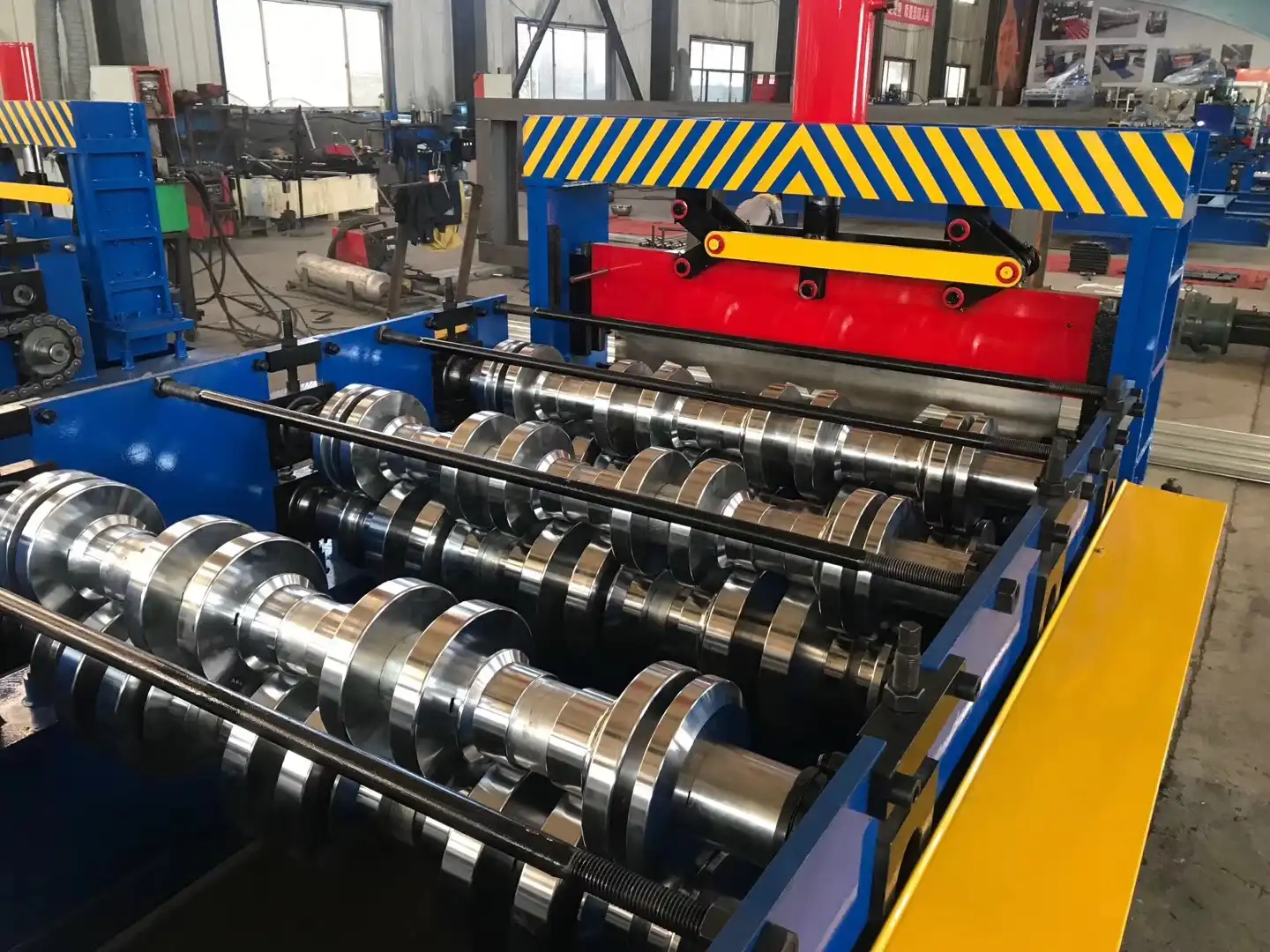
Coil that is galvanized or Galvalume (0.8–1.2 mm, 235 MPa yield strength) is fed through a series of hardened roll stations by the floor deck roll forming machine. There will be no warming, storing in between, or trucking. The raw material comes in as a coil, and the finished structure deck comes off the runout table already cut to the right length.
PLC-Driven Length Control Matches Drawing Revisions Instantly
An operator can change the panel length or rib pitch right at the touchscreen thanks to a PLC and converter control system. This machine has a 5.5 kW hydraulic unit that powers the cut-off that trims each panel to ±1 mm. If the structural engineer changes a bay size at 9 p.m., the making operator can load the new parameters before the pour in the morning.
Inline Embossing Creates the Composite Bond
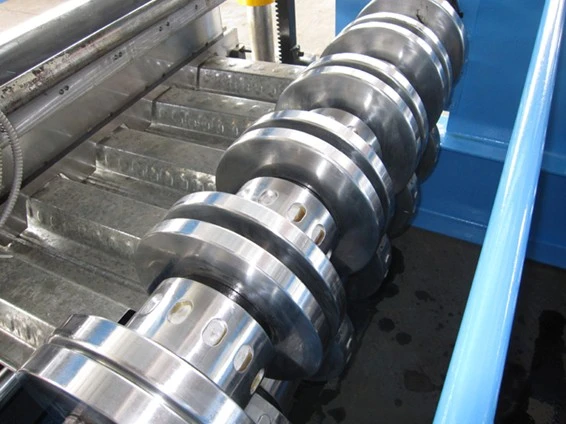
As the strip goes through, the 120 mm-diameter embossing stick makes grooves in the deck surface from contact. The shear link between the steel deck and the concrete slab above is made by these depressions. ASTM International study (ASTM E2322, 2021) shows this is needed for the composite floor to work. The slab loses its estimated combined capacity if the emboss depth is not kept the same.
Key Benefits of Running the Forming Equipment Directly on Site
Moving production from off-site to on-site isn't just about speed. In measurable ways, it also changes the way costs are structured, who is responsible for quality, and how crews work together.
Here are the main production benefits this method offers on a high-rise job site:
- Zero freight on finished panels. Coil steel ships at roughly 3× the density of pre-formed deck, so a single flatbed load of coil replaces several loads of stacked panels. One structural contractor in the Midwest reported cutting deck freight costs by 41% after moving to onsite forming on a 28-story mixed-use tower.
- Immediate quality verification. The forming crew inspects each panel as it exits the line, catching gauge drift or emboss depth variation before the panel reaches the iron crew above. Offsite inspections happen at a factory the general contractor never visits.
- Reduced storage footprint. Pre-formed panels need crane picks, laydown area, and weather protection. Coil stored vertically on the decoiler mandrel takes a fraction of that space, which matters on congested urban sites where laydown is priced by the square foot.
- Custom profiles on demand. Different floors may require a 0.6-inch form deck at roof level and a 3.0-inch composite deck at podium levels. A single floor deck roll forming machine with changeable tooling handles both without ordering two separate SKUs from an offsite supplier.
The three main problems we talked about earlier—schedule risk, material waste, and lack of design flexibility—are all fixed by these benefits.
Real-World Applications in Tall Building Projects
It has been shown that the use of this technology is helpful in circumstances when time restrictions and good structural performance are of the utmost relevance. There is a potential that this might be connected to the fact that it has been used in the past in a wide variety of projects that have been built throughout this time period. This is something that has been done in the past.
High-Rise Composite Concrete Floors
Composite slab construction is used to build office and apartment buildings with many floors. The steel deck works as both a fixed formwork and a tensile reinforcement. When the forming line is brought to the job site, the concrete contractor can pour each floor on a regular five-day cycle without having to wait for deck deliveries.
Warehouse Mezzanine Decks
Heavy-gauge industrial mezzanine work, which is usually made of 1.0–1.2 mm stainless steel, can be formed on-site because panel lengths change a lot from bay to bay. The fabricating provider doesn't order pre-cut panels from a service center; instead, they make each length as required. Material loss from projects ends up being a lot less.
Parking Structure Form Dec
Post-tensioned concrete slabs are put down on top of a fixed form deck in parking basements. The repeating bay shape and long panel runs make it perfect for high-speed forming on-site at 10–20 m/min, which is the speed range of a well-tuned composite deck forming line.
Best Practices and Maintenance for Onsite Deck Forming Lines
To ensure that a steel deck forming line continues to function properly on a building site for an extended period of time, it is vital to do routine inspections and maintenance on the line's mechanical and electrical systems. This will ensure that the line continues to function appropriately. As a result, this will ensure that the line continues to operate and function efficiently.
Daily Checks Keep the Line Running
Before each shift, operators should make sure that the forming roller shafts are properly oiled (they are made of 95 mm diameter No. 45 steel that has been chrome-treated), that the Cr12 quench-hardened cuts are not chipping, and that the hydraulic pressure is within the goal range of 18–20 MPa. Most stoppages in the middle of a shift can be avoided with a five-minute inspection before the shift starts.
Weekly Alignment Verification Protects Profile Accuracy
When roller alignment drift happens, finished panels get camber, which makes it hard for ironworkers to fit them against structural beams. Every week, a laser or dial-indicator check is done on all 27 forming stations to find any misalignment before it makes a bunch of scrap panels. The three-motor drive setup (3 × 11 kW main motors) spreads torque out widely, which lowers the twist forces that cause rollers to move out of place.
Coil Selection Directly Affects Machine Longevity
When you use Z275–Z600 galvanized or Galvalume coil with a thickness between 0.8 and 1.2 mm, the cutting forces stay within the hydraulic shear's design range. Putting too much out-of-spec material on the cutter speeds up Cr12 wear and increases the risk of blade breakage. Both the machine and the finished profile are safe when the coil is specified to ASTM A653 or an equivalent standard.
Conclusion
Forming metal decks on-site is no longer a niche business. Because of tight schedules, limited space on urban sites, and the need for composite floor profiles that meet engineer-of-record standards, more high-rise builders and deck fabricators are putting the forming line at the building itself. The information on saving on freight, cutting down on waste, and sticking to schedules backs up the investment. When buying teams look at this shift, the gauge range, forming speed, embossing ability, and quality of the drive system are the most important factors. These all affect how well the floor deck roll forming machine meets the tight schedule for pours.
FAQ
1. What gauge of steel can a composite deck forming line handle?
The machine works with galvanized or Galvalume coils that are between 0.8 mm and 1.2 mm thick and have a yield strength of 235 MPa. Standard B-deck, 1.5-inch A/B rib, and 3.0-inch composite floor deck designs are all in this range. They are used in high-rise buildings in the US.
2. How fast does the forming line produce finished panels?
Speed ranges from 10 to 20 m/min, based on the depth of the ribs and the complexity of the stamp. A thinner form deck profile usually stays near the top of that range. A deep 3.0-inch composite deck profile stays closer to 10 m/min to keep the measurements correct.
3. Can the machine switch between profile types on the same project?
Yes, different rib shapes can be made on the same line with tooling changeover. For projects that use form deck on the upper floors and composite deck on the lower levels, both can be done on the same machine. Between production runs, the tools will be changed.
4. Does onsite forming affect structural compliance?
No, as long as the material of the coil meets the requirements of ASTM A653 and the depth of the stamp stays within the design standard. The forming line's inline embossing station makes the shear-bond indentations needed for the rated performance of the composite slab.
5. What power supply does the machine require?
As normal, the line runs on 380 V, three phases, and 50 Hz. However, different voltages can be used to match the source at each site, such as 60 Hz configurations for North American sites.
Get a Quote From ZTRFM — Trusted Floor Deck Roll Forming Machine Supplier
Since 2014, ZTRFM has sold steel deck forming lines to builders in more than 150 countries. Each machine has ISO 9001, CE, and CAS certifications to back it up. We can help you find the right single-floor deck roll forming machine for your project or a full smart production line with a decoiler, stacker, and spare parts package. Our engineering team will do the research and find the best machine for you. To get a custom quote right away, email us at zhongtuorollforming@gmail.com.
References
1. Steel Deck Institute. SDI Manual of Construction with Steel Deck. Steel Deck Institute, 2022.
2. ASTM International. ASTM E2322: Standard Test Method for Conducting Transverse and Concentrated Load Tests on Panels Used in Floor and Roof Construction. ASTM International, 2021.
3. American Institute of Steel Construction. Steel Construction Manual, 16th ed. AISC, 2023.
4. Lawson, R. M., and Hicks, S. J. Design of Composite Slabs with Profiled Steel Decking. Steel Construction Institute, 2011.
5. Ghersi, A., and Landolfo, R. "Cold-Formed Steel Members in Construction: Structural Performance and Manufacturing Parameters." Thin-Walled Structures, 2019.
6. Hancock, G. J. Cold-Formed Steel Structures to the AISI Specification. Marcel Dekker, 2001.