- English
- French
- German
- Portuguese
- Spanish
- Russian
- Japanese
- Korean
- Arabic
- Irish
- Greek
- Turkish
- Italian
- Danish
- Romanian
- Indonesian
- Czech
- Afrikaans
- Swedish
- Polish
- Basque
- Catalan
- Esperanto
- Hindi
- Lao
- Albanian
- Amharic
- Armenian
- Azerbaijani
- Belarusian
- Bengali
- Bosnian
- Bulgarian
- Cebuano
- Chichewa
- Corsican
- Croatian
- Dutch
- Estonian
- Filipino
- Finnish
- Frisian
- Galician
- Georgian
- Gujarati
- Haitian
- Hausa
- Hawaiian
- Hebrew
- Hmong
- Hungarian
- Icelandic
- Igbo
- Javanese
- Kannada
- Kazakh
- Khmer
- Kurdish
- Kyrgyz
- Latin
- Latvian
- Lithuanian
- Luxembou..
- Macedonian
- Malagasy
- Malay
- Malayalam
- Maltese
- Maori
- Marathi
- Mongolian
- Burmese
- Nepali
- Norwegian
- Pashto
- Persian
- Punjabi
- Serbian
- Sesotho
- Sinhala
- Slovak
- Slovenian
- Somali
- Samoan
- Scots Gaelic
- Shona
- Sindhi
- Sundanese
- Swahili
- Tajik
- Tamil
- Telugu
- Thai
- Ukrainian
- Urdu
- Uzbek
- Vietnamese
- Welsh
- Xhosa
- Yiddish
- Yoruba
- Zulu
What makes a roofing sheet machine cut straight every time?
A roofing sheet machine delivers a straight cut when every mechanical and electronic subsystem works in sync. The hydraulic flying shear must engage at precisely the programmed length, the Siemens PLC must signal the cut at the exact moment the sheet reaches position, and the blade clearance must match the material gauge. Miss any one of those variables—even by half a millimeter—and the cut drifts, burrs form, or the panel end warps. Understanding what drives that synchronization is the real question procurement engineers and roofing manufacturers need to answer before signing a purchase order.
Understanding the Challenge of Achieving Perfectly Straight Cuts
When you see a production line running 8-hour shifts on 0.3 mm PPGI coil at high speed, straight cuts sound easy. In real life, forming lines have to deal with things like mechanical drift, coil camber, and roller expansion caused by heat that aren't shown in a factory brochure.
Why Blade Misalignment Is the Most Common Culprit
Most complaints about the quality of cuts on cold roll forming lines around the world are caused by blades that are not aligned properly. If the upper and lower shear blades are even slightly not parallel to each other, the cutting force is spread out unevenly across the width of the sheet. This makes a panel end that looks square at first glance but is actually 1–2 mm off, which is far enough to cause problems with gaps on a roof with exposed fasteners. A feeler gauge should be used to check the alignment of the blades at all times during planned maintenance, not just when the machine is first set up.
How Inconsistent Feed Rates Compound Errors
A feed rate that isn't stable makes length tolerance problems worse. If the speed of forming changes from station to station, the shear's encoder will fire at the wrong sheet position. A normal stop-to-cut hydraulic system moving at 15–20 m/min can tell the difference in length even after a half-second of hesitation. This risk is lower with flying-shear systems because the shear moves with the sheet while it is being cut. This means that there is no stop-and-start cycle that can cause location errors.
Core Components That Ensure Straight Cuts
Cutting precision is never the result of one great piece. It comes from a series of measured parts that were all made to exact specifications so that the result at the shear station can be repeated.
Here are the main mechanical and electrical parts of a cold roll forming line that control the quality of the cuts:
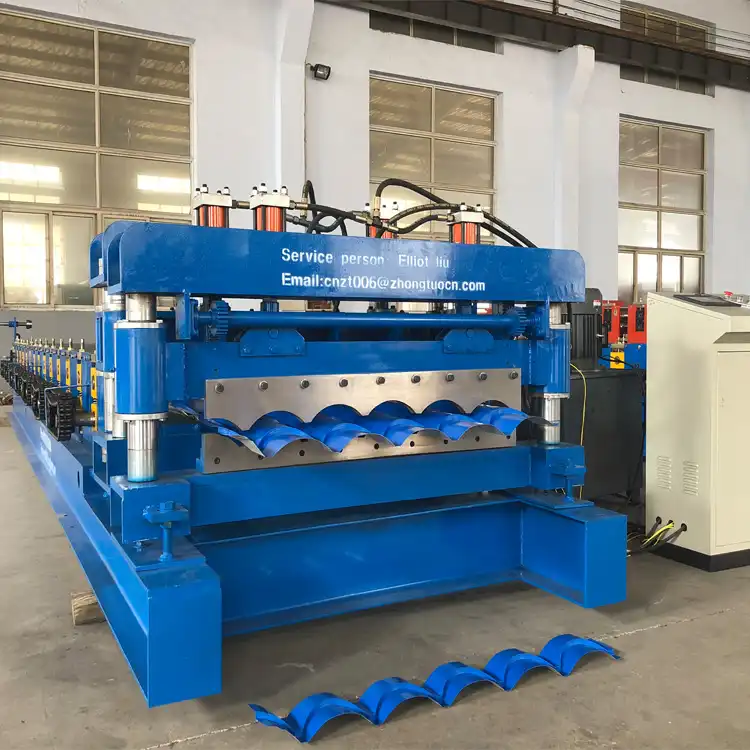
- Hydraulic flying shear with Cr12MoV blades: The hydraulic flying shear has blades made of Cr12MoV tool steel, which stays sharp even after many cuts on PPGI, GI, and Al-Zn coil without breaking. The steel has been heat-treated to HRC 58–62. The flying-shear device matches the speed of the blade to the speed of the roofing sheet machine. This way, the cut happens while the material is moving—there is no stopping or shifting of position.
- Siemens PLC control with encoder feedback: The Siemens PLC reads the rotary encoder signal all the time and starts the shear at the exact length that was programmed. A well-tuned device has a length error of ±1 mm over a 6-meter panel. Touch-screen batch programming lets workers choose the length and number of cuts without having to measure them by hand.
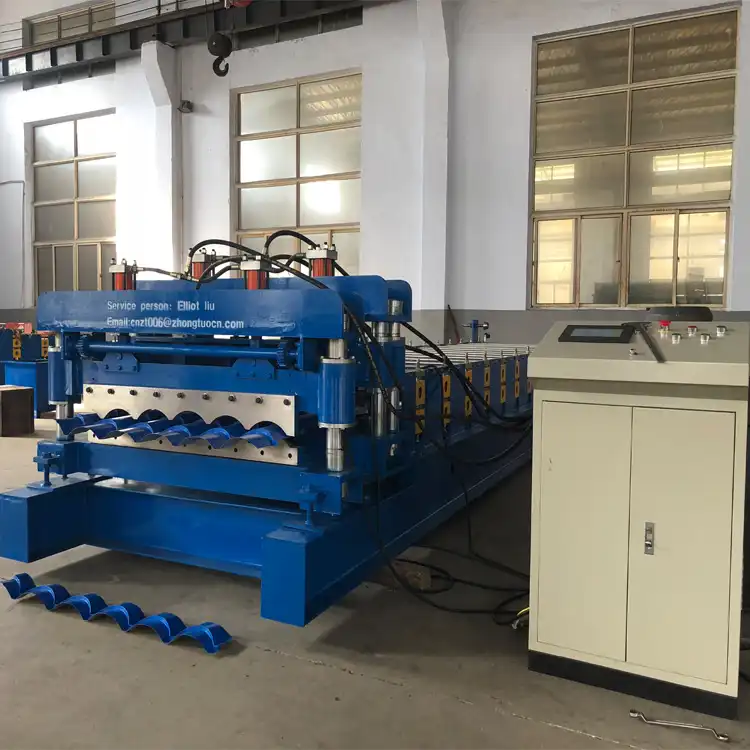
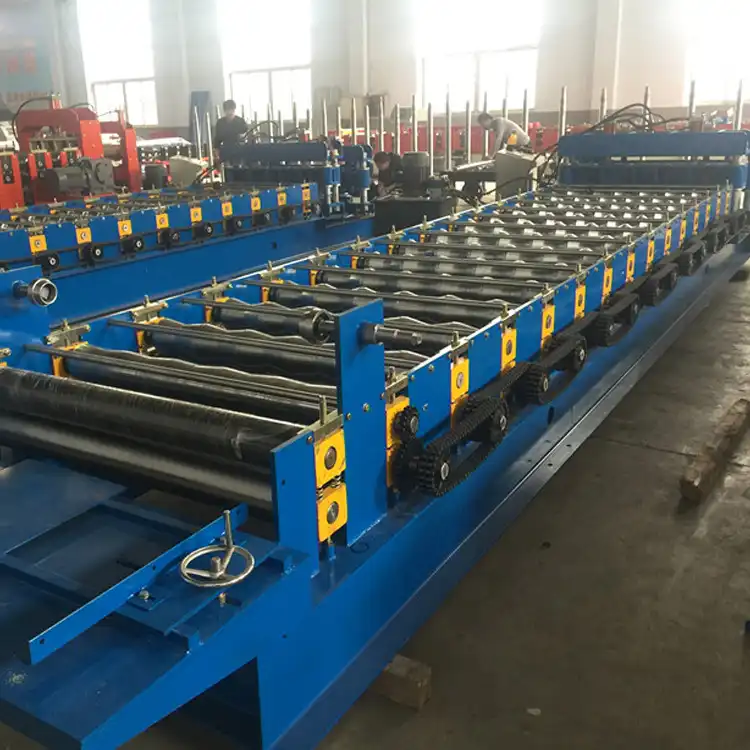
- 22-station roll-former with 80 mm solid shafts: Rollers made from 45# steel and hard chrome-plated on the outside are placed on solid rods 80 mm in diameter at each station. The diameter of the shaft is important because deflection under load is what causes profile distortion that throws off the roofing sheet machine price as it enters the shear zone.
- 400 H-steel welded machine frame: A 400 H-steel frame holds the forming bed in place. When running at high speeds, frame rigidity directly stops resonance vibration. When the frame bends, the guide rails move, which moves the sheet horizontally before it hits the blade, cutting it diagonally instead of straight across.
These benefits can successfully fix the cut-quality issues that come up with lighter-gauge machines that are built on frames that are too small and have shafts with smaller diameters.
The Decoiler's Role in Feed Stability
The material can come in from either a hydraulic decoiler or a manual decoiler. The manual unit is included for free on many of our standard lines. It is important to have a solid, tensioned uncoil feed because coil springback and horizontal wander will both move the strip out of center before it gets to the first forming pass. A hydraulic decoiler with expandable arms holds the coil ID firmly and releases the strip at a controlled rate. This keeps the strip from moving side to side as much as possible, which happens when the coil is loose.
Best Practices for Maintaining Cutting Precision
When maintenance is put off, even a well-designed machine can move out of range. Depending on how hard the material is and how often the line is used, the shear blade on a cold roll forming line for handling PPGI needs to be inspected every one to two years. Sharpening or replacing the blade before you can see wear on it stops the burrs from slowly building up, which operators often mistake for a problem with the Siemens PLC calibration.
Calibration and Lubrication Schedules That Protect Cut Quality
It is required that the shear slide part be oiled. When dry slides make heat, the blade housing expands thermally, which moves the blade gap. The upper-to-lower blade clearance is kept within the 5–10% of material thickness range by lubricating the shear guide columns once a week and measuring the blade gap with feeler gauges once a month. This makes clean, burr-free edges on materials from 0.3 mm to 0.8 mm. Each blade check should include a roller surface inspection to look for chrome flaking or surface scoring.
Operator Training as a Precision Variable
In purchase reviews, the effect of the operator on the quality of the cut is often not given enough weight. Before the batch goes on, a trained operator can spot a cut that doesn't meet specifications in the first few panels and figure out what went wrong by checking the blade gap, the encoder, or the feed tension. By letting plant workers watch and change PLC settings in real time, remote diagnostics through Siemens cloud IoT lowers the need for on-site knowledge. This is a very useful feature for buyers who run roofing sheet machine price lines in remote areas.
Evaluating Roll Forming Lines for Optimal Cutting Performance
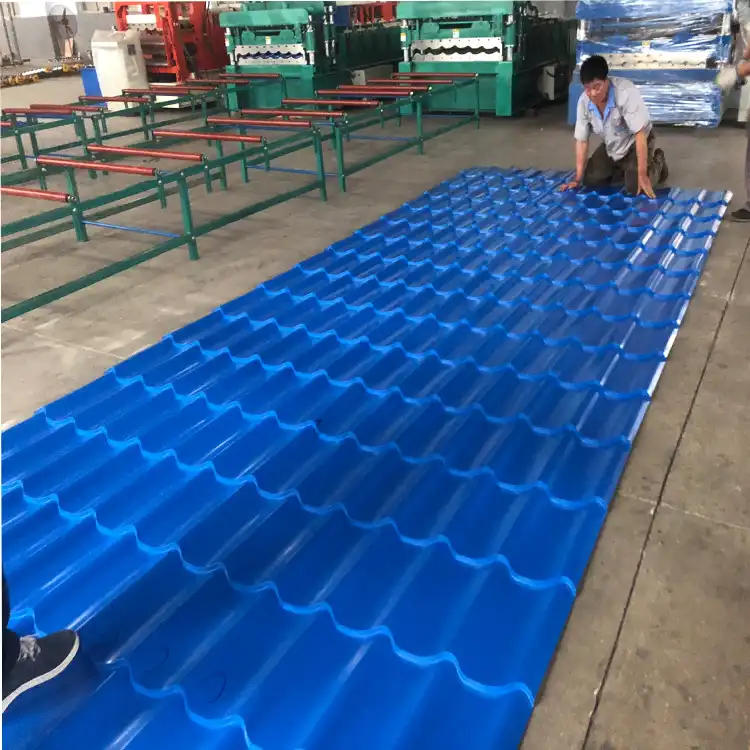
There are different lines on the market that don't all follow the same standards for structure and control. When looking at different cold roll forming lines for making panels with PBR, R-panel, IBR, corrugated, or trapezoidal profiles, the following specification checkpoints can tell the difference between long-lasting, accurate machines and cheap ones that start to move around after a few months:
- Shaft diameter of at least 75 mm (our standard is an 80 mm thick shaft)
- Frame made of steel in the shape of an H, not welded square tubes
- stop-to-cut system instead of a flying-shear cutting system for constant output
- PLC name with a history of industrial backing (Siemens is the standard for UL/ETL electrical buyers in North America).
- The rollers are made of 45# or GCr15 steel that has been hard chrome-plated and certified.
Our lines can handle gauges ranging from 0.3 mm to 0.8 mm for PPGI, GI, Al-Zn, and aluminum coil. Chain transmission powers the forming stations and can keep the torque steady, which belt drives can't do when the forming loads change.
How Precise Cutting Improves Productivity and ROI
It's not common to keep track of scrap rates as a line-item cost on a badly cutting line until a procurement audit brings them to light. A panel with a 2 mm diagonal cut mistake at one end can't be put on a roof with visible fasteners without being shimmied, which takes more time and makes the seal less reliable. This waste adds up quickly in a home project with 10,000 panels.
Our machines are used in more than 150 countries, with examples at Tata Group in India, DS Group in Korea, and HADDAD SET in Jordan. They show that consistent cut quality cuts down on rework later on and speeds up installation cycles. The Siemens cloud IoT integration increases uptime even more by letting AI help with predictive maintenance alerts that are sent before a mechanical problem gets to the shear station.
Conclusion
Four things work together to make straight cuts on a roofing sheet machine panel line: the material and gap calibration of the blades, encoder-triggered PLC control, the rigidity of the shaft and frame, and regular maintenance schedules. If you compromise on any of them, the quality of the whole batch of panels will go down. Rather than making changes to account for drift over time, efficient panel shops choose to invest in a line that is built to hold these limits from the start. The specs listed here are the same ones that ZTRFM has put into all of their regular lines since 2014.
FAQ
1. How often should I replace or sharpen the shear blade?
Our lines use Cr12MoV tool steel that has been heated to HRC 58–62 for the shear blade. When working with 0.3–0.8 mm PPGI or GI coil on a regular basis, the blade usually needs to be sharpened or replaced every 1–2 years. Wear is sped up by heavier gauges or alloys that are harder.
2. What is the length tolerance on the flying shear system?
With input from a Siemens PLC and an encoder, our flying-shear lines keep a length range of ±1 mm over panels up to 6 meters long. On slower lines, stop-to-cut hydraulic systems get about ±1.5 mm.
3. Can one machine handle multiple roofing profiles?
One profile set is made by a normal single-level line. We have cassette-type tooling (quick-change roller bases) or double-layer machines for making more than one profile. These machines let different profiles run on the same frame without having to replace all the tools.
4. Does the manual decoiler affect cut accuracy?
The free manual decoiler can handle normal coil weights and keeps the feed stable enough for most uses. If you have heavier coils or runs that go faster and lateral wander is a problem, you should get a hydraulic decoiler with motorized expansion arms.
Partner With ZTRFM for a Roofing Sheet Machine That Cuts Right Every Time
Since 2014, ZTRFM has sold cold roll forming equipment to people in more than 150 countries. They are certified by ISO 9001, CE, and CAS. You can buy standard and OEM roofing sheet machines from us. These machines have 22-station forming, Siemens PLC control, a flying shear, and 80 mm solid shafts. You can email our engineering team at zhongtuorollforming@gmail.com to ask for a video acceptance test, custom profile tools, or a low FOB quote.
References
1. Bhattacharyya, D., & Smith, P. (2012). Cold Roll Forming of Thin Sheet Metal — Deformation Mechanics and Process Design. Journal of Materials Processing Technology.
2. Halmos, G. T. (2006). Roll Forming Handbook. CRC Press / Taylor & Francis Group.
3. Lindgren, M. (2007). Experimental investigations of the roll forming process. Journal of Materials Processing Technology, 191(1–3), 333–338.
4. American Iron and Steel Institute (AISI). (2016). Cold-Formed Steel Design Manual. AISI.
5. International Organization for Standardization. (2015). ISO 9001:2015 Quality Management Systems — Requirements. ISO.
6. Sheet Metal and Air Conditioning Contractors' National Association (SMACNA). (2012). Architectural Sheet Metal Manual (7th ed.). SMACNA.