- English
- French
- German
- Portuguese
- Spanish
- Russian
- Japanese
- Korean
- Arabic
- Irish
- Greek
- Turkish
- Italian
- Danish
- Romanian
- Indonesian
- Czech
- Afrikaans
- Swedish
- Polish
- Basque
- Catalan
- Esperanto
- Hindi
- Lao
- Albanian
- Amharic
- Armenian
- Azerbaijani
- Belarusian
- Bengali
- Bosnian
- Bulgarian
- Cebuano
- Chichewa
- Corsican
- Croatian
- Dutch
- Estonian
- Filipino
- Finnish
- Frisian
- Galician
- Georgian
- Gujarati
- Haitian
- Hausa
- Hawaiian
- Hebrew
- Hmong
- Hungarian
- Icelandic
- Igbo
- Javanese
- Kannada
- Kazakh
- Khmer
- Kurdish
- Kyrgyz
- Latin
- Latvian
- Lithuanian
- Luxembou..
- Macedonian
- Malagasy
- Malay
- Malayalam
- Maltese
- Maori
- Marathi
- Mongolian
- Burmese
- Nepali
- Norwegian
- Pashto
- Persian
- Punjabi
- Serbian
- Sesotho
- Sinhala
- Slovak
- Slovenian
- Somali
- Samoan
- Scots Gaelic
- Shona
- Sindhi
- Sundanese
- Swahili
- Tajik
- Tamil
- Telugu
- Thai
- Ukrainian
- Urdu
- Uzbek
- Vietnamese
- Welsh
- Xhosa
- Yiddish
- Yoruba
- Zulu
Portable roof panel machine or stationary line: which pays back?
If you are comparing a portable roof panel machine to a permanent manufacturing line, the quick answer is: it is contingent upon how you operate. A portable mill may help contractors who travel between construction sites recoup costs more quickly by eliminating panel freight, reducing waste from pre-cut mistakes, and allowing crews to produce exact-length standing seam panels directly on the roof. Factories or distributors with significant daily volume often choose a fixed line for its constancy in throughput. This article teases out both choices in terms of cost, performance, and procurement realities so you can make a decision based on data.
Understanding Portable Roof Panel Machines vs. Stationary Lines
Before comparing payback timeframes, it is helpful to have a solid understanding of the functions that each kind of machinery performs on the manufacturing floor or on the construction site. It is important to note that every category of apparatus serves a diverse range of operations.
How Portable Roll-Forming Mills Work
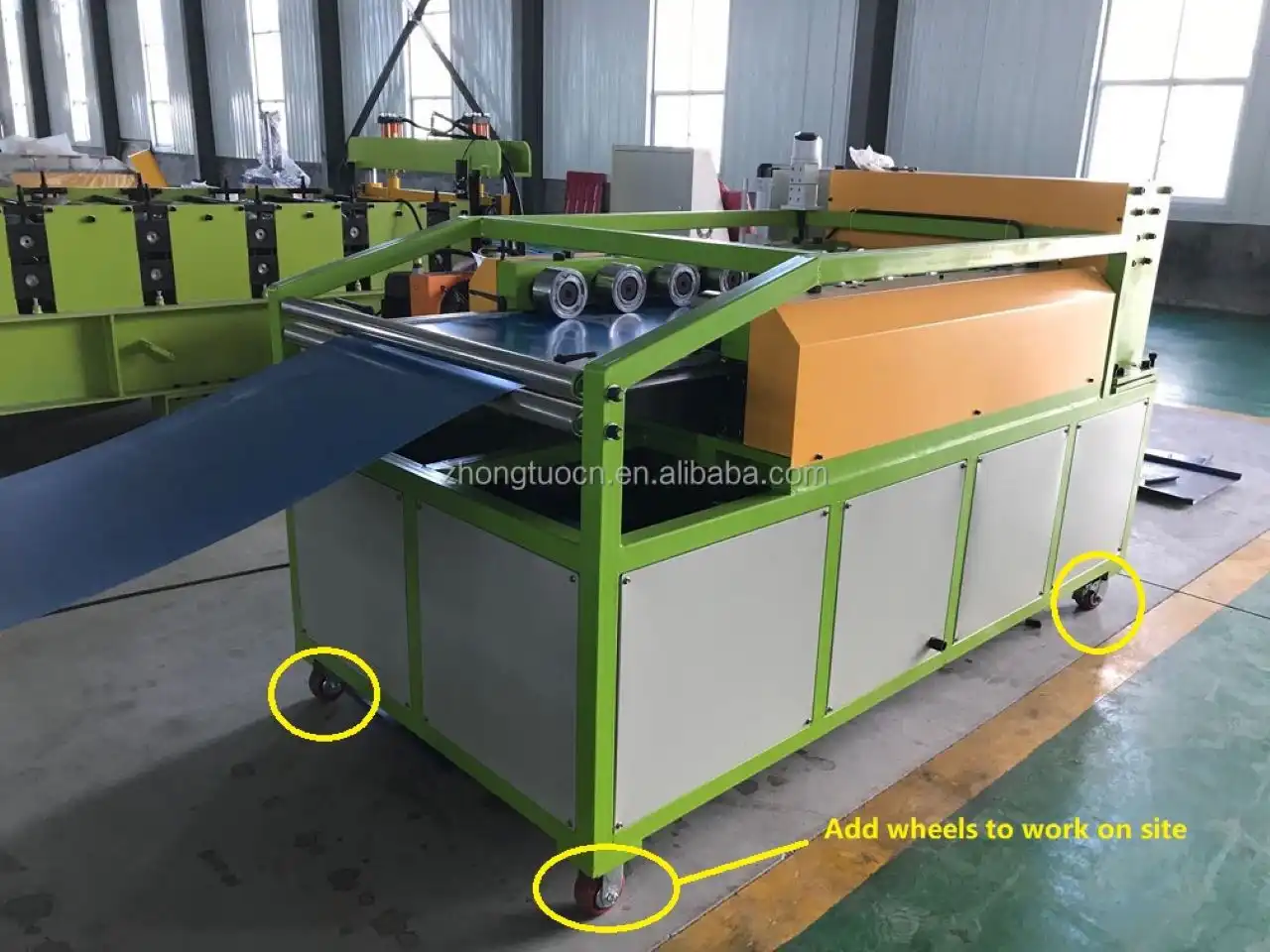
A portable roll-forming mill is mounted on a trailer frame and brought along on travels with the workforce. The machine takes a coil of steel or aluminum, molds it at numerous stages, and the final standing seam panel goes directly to the building. ZTRFM trailer-mounted devices can process PPGI, GI, and aluminum coil with a width from 0.3 mm to 0.6 mm. They achieve this using 7 roller stations with 45# steel hard chrome plated rollers and 60 mm strong shafts. The gear drive arrangement maintains the forming speed constant when the gauge changes.
How Stationary Production Lines Work
In a work site or delivery yard, a stationary line is made. It can be hooked up to longer decoiler banks, robotic stackers, and cut-to-length conveyors built directly in. Typically, you’ll get more done in a shift, but you have to transport, truck, and unload each panel at the job site. This is more time-consuming and more likely to cause damage to long-span architectural panels.
Key Design Differences That Affect Your Decision
The logistics are the difference. With portable equipment, freight is no problem whatsoever. A line that digs in one spot sacrifices movement for mass. For architects working on high-end private or governmental projects such as airports, schools, and beach houses, the ability to create continuous panels of any length on-site is not simply a convenience; it’s a quality advantage that can be quantified.
Evaluating Cost Factors and Payback Periods
The price of the equipment is the first thing people look at, but it's not always the number that tells you how much you'll make back.
Upfront Investment Comparison
In most circumstances, a portable standing seam roll former will be less expensive than a whole fixed manufacturing line. This is because the portable unit has its own base, hydraulic automated decoiler (or free hand decoiler with ZTRFM portable roof panel machines), and forming body. A permanent line requires additional floor anchors, infrastructure for transferring materials, and typically a larger power service. A portable mill for beginners will cost between $25,000 and $60,000 USD depending on the complexity of the profile and motor arrangement.
Operational Costs and Hidden Savings
Most purchasers do not include these items in their overall operating cost calculations:
- Freight elimination. Shipping pre-formed standing seam panels, particularly panels above 6 meters, adds substantial expense per project. A portable mill means that the freight line item is nil.
- Scrap reduction: On-site forming allows the operator to cut panels to the precise specified length. Pre-ordered panels have an average waste factor of 3 to 8 percent due to measurement tolerances or design modifications.
- Risk of downtime: ZTRFM machines use Siemens cloud IoT and AI remote maintenance monitoring that decreases diagnosis time and eliminates unexpected downtime on active work sites.
- Maintenance budget: 45# steel hard-chrome rollers on a 60 mm solid shaft maintain dimensional tolerances longer than softer tooling, lowering roller replacement frequency.
These savings pile up fast over several jobs in a year; thus, portable roll-forming service businesses often estimate the equipment pays for itself in 18 to 24 months of continuous usage.
ROI Scenarios by Buyer Type
A roofing worker who does eight to twelve standing seam jobs a year will usually get their money back faster with a portable machine than with a stationary line. This is because each project pays for some of the capital cost and makes money directly from labor and materials. A wholesaler that handles a lot of standard-width snap-lock panels every day for local builders might choose the fixed method, where margin per meter is driven by throughput efficiency.
Performance, Efficiency, and Durability Comparison
Even though price is important, a machine that doesn't work well will wipe out profits faster than any price.
Output Quality and Profile Accuracy
Precision-ground rollers are what separate an architectural-grade seam from a panel that needs to be fixed. ZTRFM's 45# steel rollers with a hard chrome plating finish make seams that are the same shape across the whole gauge range, from 0.3 mm to 0.6 mm. The 7-station roller setup forms the coil gradually without putting too much stress on the metal. This is important, especially for PVDF-coated or Galvalume materials, where surface marks can be seen after the job is done.
Machine Lifespan and Maintenance Expectations
A well-made portable standing seam mill with solid-shaft roller stations and a gear drive will usually work well for 10 to 15 years on a regular job site. The steel-panel body and square-tube welding frame prevent torsional flex during shipping, which is what wears out lighter-framed competing units the fastest. Most of the normal upkeep is taken care of by lubricating the gears, inspecting the rollers, and changing the hydraulic fluid on a regular basis.
Safety, Site Preparation, and Compliance
In the US, portable mills must meet UL/ETL electrical guidelines. People who want to buy one should make sure it does this before they do so. For workshops to use stationary lines, they need more formal electrical hookups, guard installations, and sometimes even local permits. On-site movable units need a flat surface and enough room to stage the coils, but they don't need to be permanently installed. ZTRFM machines are certified by ISO 9001, CE, and CAS, which means they are export-compliant and make sure quality products.
Procurement Considerations for Global B2B Clients
Choosing the right machine also means choosing the right supplier relationship, particularly for US buyers ordering from overseas manufacturers.
Supplier Qualification Criteria
The critical aspects when selecting a portable roof panel machine provider are certifications (ISO 9001, CE), reference installations in similar markets, and the availability of video acceptance testing before shipping, which is a normal expectation among North American purchasers. Established in 2014 in Cangzhou’s Botou, the capital of roll-forming equipment in China, ZTRFM has machinery operating in over 150 countries, with reference customers including Tata Group (India), DS Group (Korea), and HADDAD SET (Jordan).
Shipping, Warranty, and Financing Options
The portable units are shipped in small crates suitable for normal 20-foot containers. ZTRFM offers the entire set of paperwork packages for customs clearance and arranges pre-shipment video inspections on request. It is important to confirm warranty conditions, availability of replacement parts, and response time of technical assistance before ordering. The company’s cooperation with Siemens provides cloud-based diagnostics to faraway customers without the need for an on-site professional.
OEM and Custom Profile Options
ZTRFM’s OEM/ODM service may produce unique seam heights, panel widths, and clip tooling under NDA for contractors with proprietary seam profiles, or for distributors constructing a premium product tier. The same machine frame may be supplied with snap-lock or mechanical-seam die sets, protecting the equipment investment when project profiles change.
Which Machine Pays Back? Decision Support for B2B Buyers
The answer is not universal, but the pattern is consistent enough to give clear guidance for most buyer types.
Match Machine Type to Your Business Model
Portable roll-forming machines have a quicker payback when mobility is part of the value offer – roofing contractors invoicing for on-site panel manufacture, service firms moving between projects, or solar EPC installations needing seam-compatible panels made to specific dimensions on each job. If the daily volume is the most important factor, then stationary lines provide a quicker pay-off, e.g., a distributor operating two or three shifts to fill a regional dealer network.
Pros and Cons at a Glance
Both machine types have actual trade-offs that must be acknowledged up front:
- Strengths of Portable Mills: No freight cost for panels; continuous-length panels; no end-laps; quick site deployment; lower entry investment; flexibility of OEM profile
- Disadvantages of portable mill: lower maximum throughput per shift compared to a fully automated fixed plant, transit problems between projects.
- Stationary line strengths: Higher production volume, simpler integration with automated stacking and packing, more suited to standardized profile ranges.
- Trade-offs with stationary line: higher infrastructure cost, panel transport cost and damage risk on each project delivery, less flexible to bespoke or one-off panel lengths.
Understanding these trade-offs allows procurement managers to relate equipment decisions directly to the revenue model, not simply machine specifications.
Final Recommendation
For most U.S. architectural metal roofing contractors and job-site roll-forming service organizations, a portable standing seam machine will pay for itself in under two years if utilized regularly on jobs. The freight savings, scrap reduction, and on-site quality monitoring add margin to every roof plane. Buyers developing a distribution-scale business recuperate the premium cost of a fixed line with automated handling on volume production over a longer horizon.
Conclusion
The payback period depends on your company model. Portable tools provide rapid cost recovery and independence on site, a huge bonus for project-based contractors. Manufacturers and distributors who are volume-oriented will find fixed lines useful. Since 2014, ZTRFM has been selling ISO 9001, CE, and CAS-certified portable and permanent standing seam portable roof panel machines to contractors in over 150 countries. The following step is straightforward if you are ready to check the specifications or get a price on a bespoke profile.
FAQ
1. What gauge material can a portable standing seam machine process?
ZTRFM portable units process PPGI, GI, and aluminum coil from 0.3 mm to 0.6 mm (approximately 24–26 gauge), covering the full range used in architectural standing seam and snap-lock applications.
2. Does the machine come with a decoiler?
Yes. ZTRFM includes a hydraulic automatic decoiler as standard. A manual decoiler is provided free of charge with each unit, giving operators a backup option on sites where hydraulic power is limited.
3. How many roller stations does the machine have?
The standard configuration uses 7 roller stations with a 60 mm solid-shaft design. Custom station counts are available on request through ZTRFM's OEM program.
4. Can the machine produce both snap-lock and mechanical-seam profiles?
Yes. ZTRFM machines accept both snap-lock and mechanical-seam die sets from the same frame, allowing contractors to switch profile types without purchasing a second machine.
5. What certifications does the machine carry?
ZTRFM machines are certified to ISO 9001, CE, and CAS standards. US buyers should confirm UL/ETL electrical compliance for their specific unit configuration before order placement.
Get Your Custom Quote from ZTRFM — Portable Roof Panel Machine Supplier
ZTRFM makes movable roof panel machines that are made to work on real job sites. Our portable roof panel machines are designed to make a profit from the very first project. They have precision-ground rollers, Siemens IoT-monitored controls, and OEM/ODM profile tooling that can be used. You can ask for specs, a video acceptance test, or a unique profile consultation by emailing us at zhongtuorollforming@gmail.com. When US companies and B2B buying teams ask us a question, our team answers right away.
References
1. Metal Construction Association. Guide to Metal Roofing: Standing Seam Systems. Metal Construction Association, 2021.
2. ASCE. Minimum Design Loads and Associated Criteria for Buildings and Other Structures (ASCE 7-22). American Society of Civil Engineers, 2022.
3. ASTM International. ASTM E1592: Standard Test Method for Structural Performance of Sheet Metal Roof and Siding Systems. ASTM International, 2019.
4. RS Means Building Construction Cost Data. Gordian Group, 2023.
5. Bryson, L.S., and Chini, A.R. "Prefabrication and On-Site Fabrication Trade-Offs in Metal Roofing Installation." Journal of Construction Engineering and Management, ASCE, 2020.
6. S-5! Metal Roof Innovations. White Paper: Seam-Mounted Solar Attachment Systems and Wind Uplift Performance. S-5! Metal Roof Innovations, 2022.