- English
- French
- German
- Portuguese
- Spanish
- Russian
- Japanese
- Korean
- Arabic
- Irish
- Greek
- Turkish
- Italian
- Danish
- Romanian
- Indonesian
- Czech
- Afrikaans
- Swedish
- Polish
- Basque
- Catalan
- Esperanto
- Hindi
- Lao
- Albanian
- Amharic
- Armenian
- Azerbaijani
- Belarusian
- Bengali
- Bosnian
- Bulgarian
- Cebuano
- Chichewa
- Corsican
- Croatian
- Dutch
- Estonian
- Filipino
- Finnish
- Frisian
- Galician
- Georgian
- Gujarati
- Haitian
- Hausa
- Hawaiian
- Hebrew
- Hmong
- Hungarian
- Icelandic
- Igbo
- Javanese
- Kannada
- Kazakh
- Khmer
- Kurdish
- Kyrgyz
- Latin
- Latvian
- Lithuanian
- Luxembou..
- Macedonian
- Malagasy
- Malay
- Malayalam
- Maltese
- Maori
- Marathi
- Mongolian
- Burmese
- Nepali
- Norwegian
- Pashto
- Persian
- Punjabi
- Serbian
- Sesotho
- Sinhala
- Slovak
- Slovenian
- Somali
- Samoan
- Scots Gaelic
- Shona
- Sindhi
- Sundanese
- Swahili
- Tajik
- Tamil
- Telugu
- Thai
- Ukrainian
- Urdu
- Uzbek
- Vietnamese
- Welsh
- Xhosa
- Yiddish
- Yoruba
- Zulu
Supplying T grid ceilings with a ceiling t bar roll forming machine
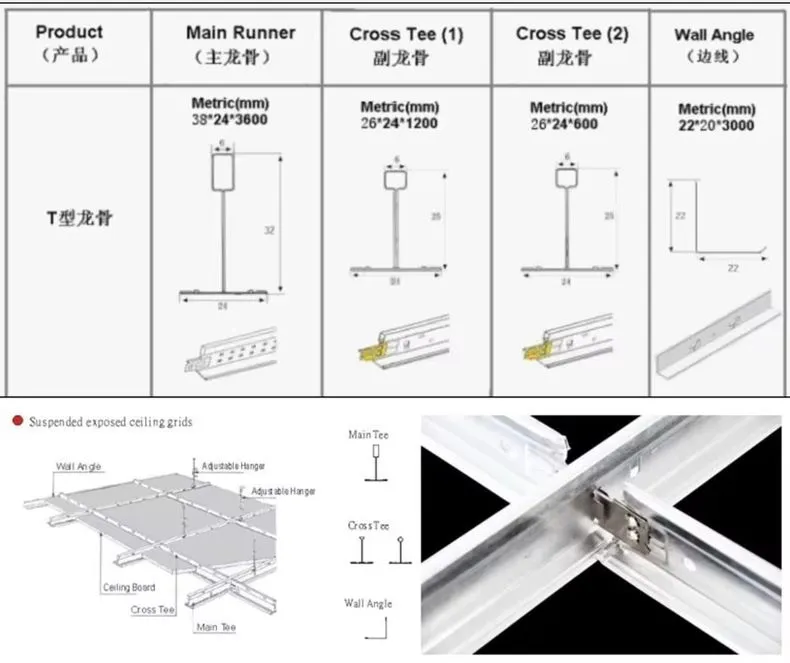
Supplying T-grid ceilings at scale demands more than raw materials and labor — it demands precision machinery. A ceiling T bar roll forming machine processes PPGI or GI steel coil through a sequence of roller stations, continuously shaping thin-gauge strip into the Main Tee and Cross Tee profiles that form the backbone of every suspended ceiling system. Whether you manufacture ceiling grids for commercial offices, retail malls, or prefab housing, understanding how this equipment works — and how to procure it wisely — directly impacts your output quality, production cost, and competitive positioning.
Understanding Ceiling T Bar Roll Forming Machines
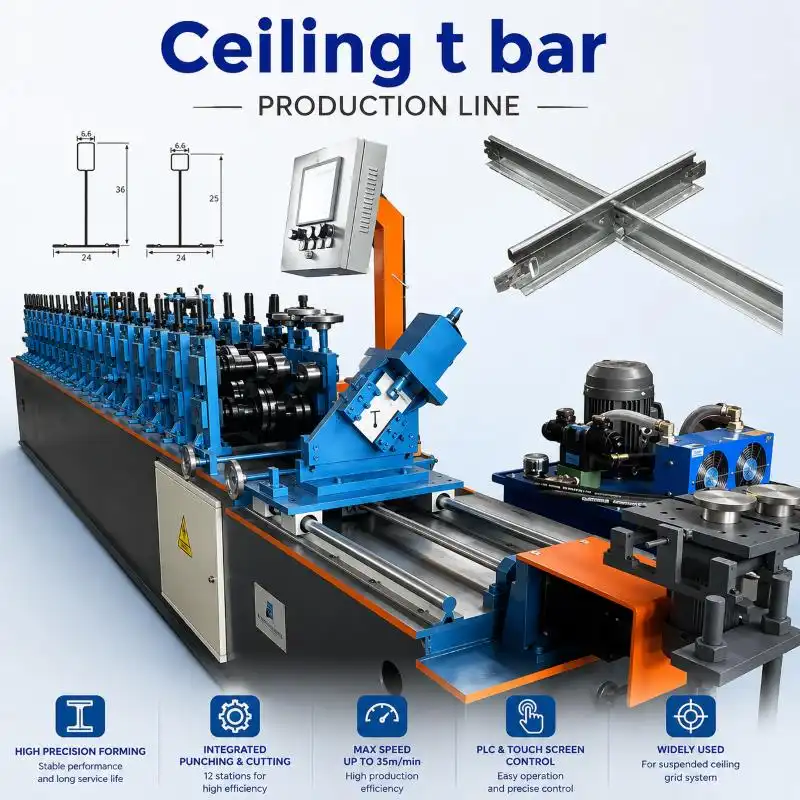
A ceiling T-bar roll forming machine is a cold-forming production line designed to precisely shape a flat metal coil into a T-shaped grid without heating the metal. The process starts at the decoiler and goes through a series of roller stations that bend the strip more and more. It ends at the cutting unit, where the finished bars are cut to length.
How the Roll Forming Process Works
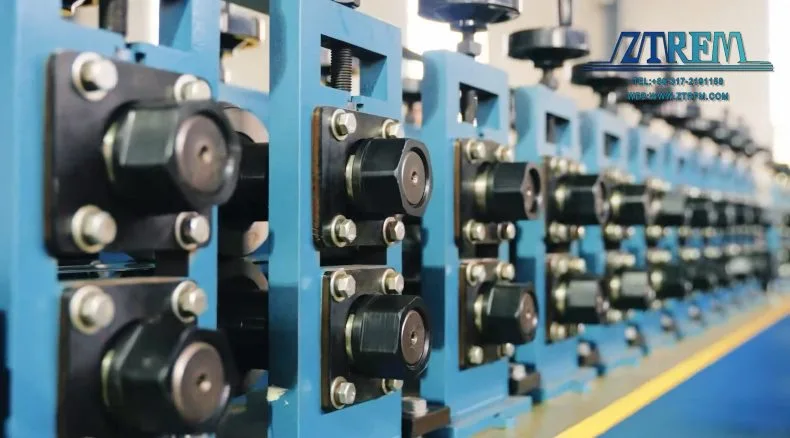
A decoiler that can hold 1.5 tons of material and coils with an inner diameter of 450 to 550 mm is used to load raw PPGI coil (0.12 to 0.3 mm thick for T bar top material) or GI coil (0.2 to 0.4 mm thick for T bar bottom material). Roller stations made of GB-Cr12 tool steel move the strip through them. There are 18 stations for the Main Tee profile and 16 stations for the Cross Tee profile. Each station makes the shape of the material a little clearer until the finished T bar emerges. The line moves at a speed of 0–20 m/min and punches and cuts straight, so the shape is the same on every meter that is made.
Automatic vs. Semi-Automatic Models
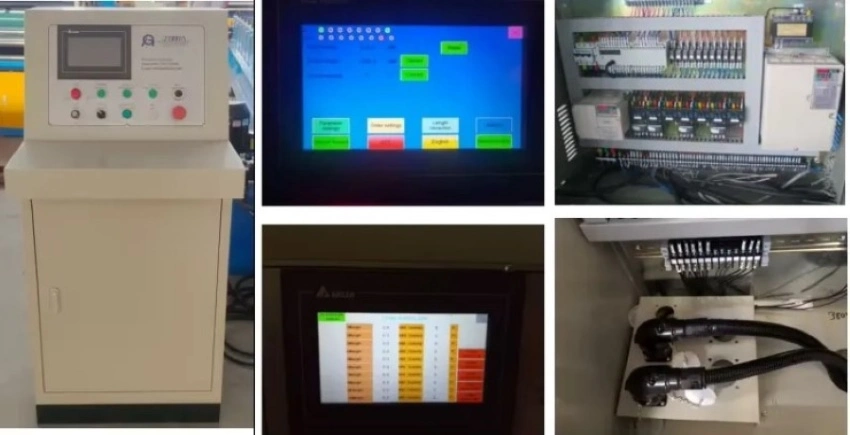
Fully automatic lines include PLC control, servo-driven punching, and flying-cut hydraulic slicing. This reduces the need for human work and allows for continuous high-volume runs. Smaller businesses can use semi-automatic configurations because operators can change the coils and set the cut-to-length settings by hand. A fully automatic line with servo feed gives most B2B buyers who are looking for business building supplies the throughput and repeatability that the market needs.
Benefits and Features of Using Ceiling T Bar Roll Forming Machines
When you switch from low-end or manual fabrication to a dedicated roll forming line, the economics of your whole production change. The ceiling t bar roll forming machine replaces messy hand-bending with a constant mechanical process that keeps flange width and profile height within ±0.1 mm of each other. This is close enough to ensure that 600x600 mm mineral fiber tiles always fit flat.
Here are the main benefits this equipment brings to a business that makes ceiling grids:
- High output consistency: The 18-station roller sequence for Main Tee profiles makes sure that every bar leaves the line with the same cross-section geometry. This gets rid of the camber and twist problems that happen when sections are formed by hand. A laser check of the flatness of a 3.6-meter Main Tee should show that it isn't off by more than 1 mm per length.
- Surface protection on PPGI: GB-Cr12 rollers are CNC-machined and hard chrome-plated so they don't scratch surfaces that have already been painted. The speed synchronization between stations is set up to stop relative sliding, which means that the decorative coating on the PPGI strip gets to the stacker whole.
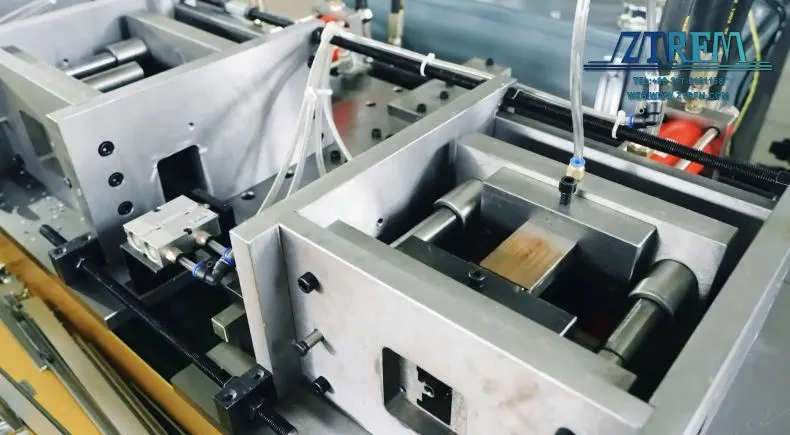
- Integrated punching and clip attachment: Advanced lines punch connection holes every 150 mm and rivet hardened steel end clips to Cross Tee ends in a single hydraulic station pass. This automation achieves pull-out strengths that are higher than 100 kg, which is a level of performance that meets the structural needs of commercial suspended ceiling installations.
- Rapid coil changeover: The decoiler shaft's 50 mm diameter and 45# steel construction allow for quick mandrel adjustment, which cuts down on coil swap time and keeps the line running while materials change.
These features directly help ceiling grid manufacturers deal with the quality and quantity issues they face when they supply commercial building projects. Cutting down on scrap, repair, and cycle times all add up to a cost benefit that can be seen over the course of a production year.
How to Choose the Right Ceiling T Bar Roll Forming Machine for Your Business
Buying roll forming equipment depends on how well the machine's capabilities match your production needs. Buying too much capacity wastes money, and buying lines that are too small creates bottlenecks that make it hard to meet big contracts.
Matching Capacity to Production Scale
If everything stays the same, a line moving at 20 m/min and punching and cutting inline can make about 1,200 m of finished T bar an hour. Compare that to the number of orders you get every month before you set speed standards. Wholesalers who work with many distributors need their decoilers to be up and running as much as possible and quickly switched over. OEMs that make private-label profiles need flexible servo-driven punching and tooling drawings that are protected by an NDA.
OEM and Custom Tooling Options
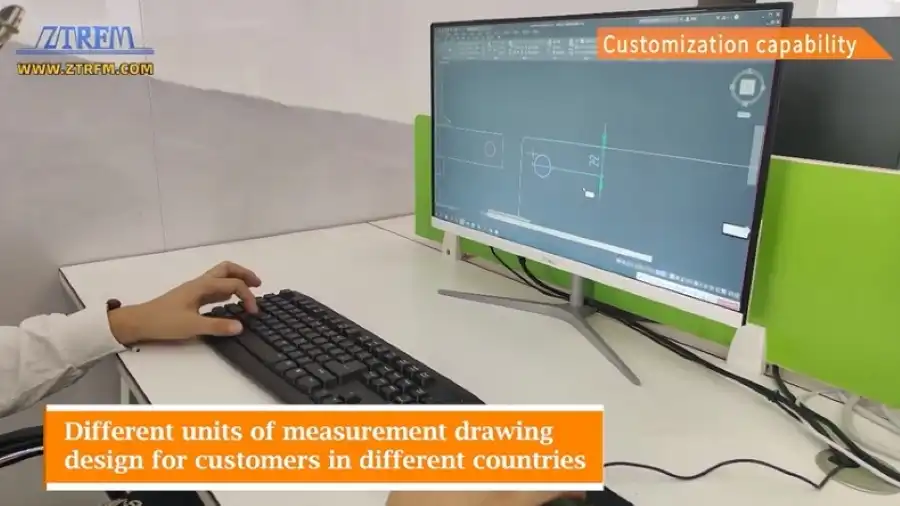
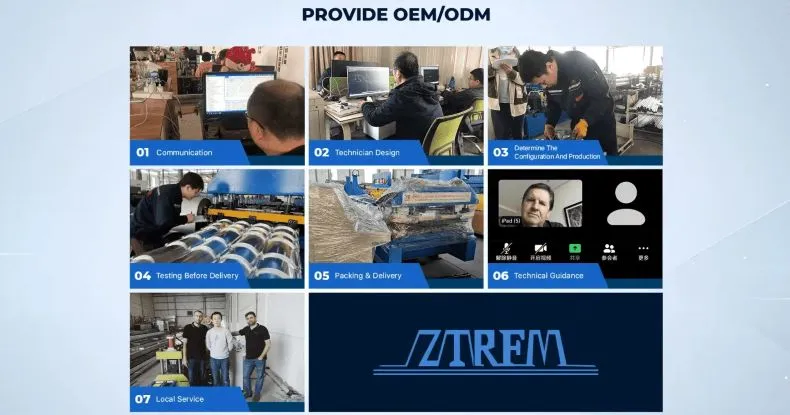
Buyers of named ceiling systems need more than just a basic line. With a multi-profile cassette system, one ceiling t bar roll forming machine can quickly switch between Main Tee and Cross Tee tooling. On the profile flange, inline embossing tools can print brand marks or custom dimple designs. If your product plan calls for unique clip geometries or custom hole patterns for service integration, make sure the supplier offers OEM/ODM tooling with secure design documentation before you sign anything.
Certifications and Control System Quality
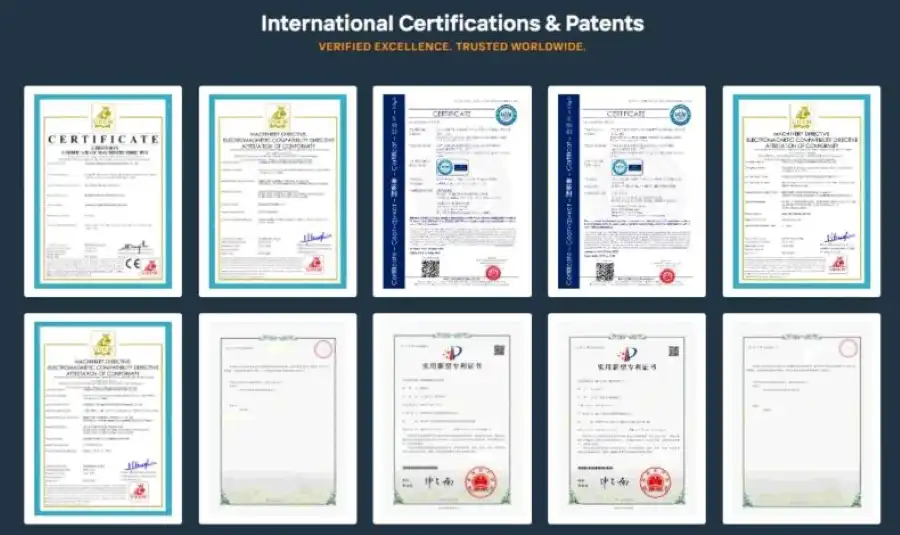
When machines are certified to ISO 9001, CE, or CAS norms, the quality of their making is checked by a third party. PLC control systems that use Siemens or Mitsubishi platforms make sure that extra parts are available all over the world and reduce reliance on service networks that are only available in certain countries. When Siemens cloud IoT integration is added, remote diagnostics become possible. This is useful when a production line works during multiple shifts without having engineers on-site to help.
Procurement Guide: Buying and After-Sales Services
To find the best machine at a good price, you need to do more than just compare prices from different suppliers. Find out the total cost of ownership, which includes things like roller wear, extra punching dies, hydraulic fluid management, and the journey of the commissioning expert.
There is a lot of repetitive stress on punching dies. Burrs on the edges of slots can't form if you sharpen die punches every 100,000 strokes and keep up with a PLC-integrated stroke counter warning system. This is because burrs are a quality flaw that leads to installation failures on-site. Before you finish your budget, add this upkeep plan to your model of how much it costs to run your business.
Capital equipment needs to be shipped in a certain way. When you use CIF pricing, your freight and insurance costs are combined, which makes it easier for buyers in North America to figure out their landed costs. Make sure that the guarantee covers forming parts for at least 12 months and includes remote troubleshooting help. The global service infrastructure that lowers procurement risk is shown by suppliers that work in more than 150 countries and have installed their products at well-known industrial groups like Tata Group in India or DS Group in Korea.
Case Studies and Real-World Applications
In the Philippines, a medium-sized company that makes ceiling grids added custom embossed Cross Tees to its normal 600x1200 mm Main Tee profiles for a store chain fit-out project. By moving to a dual-profile T-grid line with cassette changeover, the maker cut down on downtime between runs by about 40% and met the needs of the branded profile without having to hire outside help. During a 200,000-piece run, the servo-driven punching station kept the clips in the same place, which got rid of the installation problems that had happened with a previous batch that was crimped by hand.
A Southeast Asian company that builds prefab villas built a ceiling grid line right into the building where it makes light-gauge steel frames. By running 0.3 mm thick GI strip through a 16-station Cross Tee configuration, the operation was able to get a steady supply of grid for mezzanine lining and internal partition work without having to rely on outside sources of ceiling materials. At that size, vertical integration cut the cost of materials per unit and saved project lead times by getting rid of a buying level.
Conclusion
There is a ceiling t bar roll forming machine at the heart of any quality-driven, scalable T grid ceiling supply business. Using exact roller station sequencing, inline punching, and surface-protective tooling turns raw PPGI and GI coil into commercial-grade ceiling grid profiles that meet the needs of current building projects for accuracy in shape and strength. The three choices that determine whether the equipment is a competitive asset or a maintenance liability are matching the machine's specs to the size of your production run, buying OEM tools when your market needs branded profiles, and choosing a supplier with verifiable global installations and ISO-certified manufacturing practices.
FAQ
1. Can one machine produce both Main Tee and Cross Tee profiles?
With cassette-based tooling systems, you can switch between the Main Tee (18 stations) and Cross Tee (16 stations) configurations on the same frame. However, dedicated lines for each profile give you more throughput and don't require any downtime for switching between profiles during high-volume operations.
2. What maintenance does the punching die require?
Punching dies need to be sharpened every 100,000 times they are used. Most PLC systems have a stroke counter that lets operators know when maintenance is needed. This keeps connector slots from getting burrs.
3. How does the machine protect PPGI surface coatings?
GB-Cr12 rollers with hard chrome plating and precise inter-station speed synchronization keep the coating from wearing off from the decoiler to the stacker by stopping rolling against the painted surface.
4. What cutting length tolerance can I expect?
Servo-driven flying-cut systems can make 3,600 mm Main Tee bars with a length tolerance of ±0.5 mm. This is accurate enough for modular 600x600 mm tile alignment.
5. Is custom hole-pattern punching available for service integration?
Servo-driven punching stations can be set up with unique die sets for private slot geometries, dimple patterns, or fire expansion notches. OEM tooling plans are kept secret under an NDA.
Upgrade Your Ceiling Grid Output with ZTRFM
The ceiling t bar roll forming machine is a specialty of ZTRFM, which offers fully automatic, ISO 9001, CE, and CAS-approved lines to ceiling grid manufacturers in more than 150 countries. We offer decoilers, forming stations, inline punches, stackers, spare parts, and OEM tools all in one place. Tata Group, DS Group, and HADDAD SET all use our tools in their factories because they trust them. To get a custom quote right away, email your profile drawings and production goals to zhongtuorollforming@gmail.com.
References
1. Steel Framing Industry Association (SFIA) — Standard for Cold-Formed Steel Framing, 2022.
2. ASTM International — ASTM C635: Standard Specification for the Manufacture, Performance, and Testing of Metal Suspension Systems for Acoustical Tile and Lay-In Panel Ceilings, 2022.
3. Sheet Metal Industries — "Advances in Roll Forming Technology for Architectural Profiles," 2021.
4. Halmos, G. T. — Roll Forming Handbook, CRC Press, 2006.
5. Metal Construction News — "Suspended Ceiling Systems: Material Trends and Manufacturing Efficiency," 2023.
6. American Iron and Steel Institute (AISI) — Cold-Formed Steel Design Manual, 2020.