- English
- French
- German
- Portuguese
- Spanish
- Russian
- Japanese
- Korean
- Arabic
- Irish
- Greek
- Turkish
- Italian
- Danish
- Romanian
- Indonesian
- Czech
- Afrikaans
- Swedish
- Polish
- Basque
- Catalan
- Esperanto
- Hindi
- Lao
- Albanian
- Amharic
- Armenian
- Azerbaijani
- Belarusian
- Bengali
- Bosnian
- Bulgarian
- Cebuano
- Chichewa
- Corsican
- Croatian
- Dutch
- Estonian
- Filipino
- Finnish
- Frisian
- Galician
- Georgian
- Gujarati
- Haitian
- Hausa
- Hawaiian
- Hebrew
- Hmong
- Hungarian
- Icelandic
- Igbo
- Javanese
- Kannada
- Kazakh
- Khmer
- Kurdish
- Kyrgyz
- Latin
- Latvian
- Lithuanian
- Luxembou..
- Macedonian
- Malagasy
- Malay
- Malayalam
- Maltese
- Maori
- Marathi
- Mongolian
- Burmese
- Nepali
- Norwegian
- Pashto
- Persian
- Punjabi
- Serbian
- Sesotho
- Sinhala
- Slovak
- Slovenian
- Somali
- Samoan
- Scots Gaelic
- Shona
- Sindhi
- Sundanese
- Swahili
- Tajik
- Tamil
- Telugu
- Thai
- Ukrainian
- Urdu
- Uzbek
- Vietnamese
- Welsh
- Xhosa
- Yiddish
- Yoruba
- Zulu
Box Beam Roll Forming Machine: The 2026 Comprehensive Guide
If you're evaluating a box beam roll forming machine for your racking production line, this guide is written for you. Whether you manufacture pallet-rack beams, supermarket shelf supports, or mezzanine joists, getting the machine selection right in 2026 matters more than ever. This guide covers everything from how the equipment works and what specs to look for, to how ZTRFM's fully automatic system can reduce your labor costs and boost throughput — all in plain language.
Understanding Box Beam Roll Forming Machines What It Is and How It Works
A box beam roll forming machine is a fully automated production line that turns flat steel coil into closed rectangular profiles. These are the horizontal load-bearing parts of warehouse shelving. At the start of the process, an uncoiled steel strip is put through a series of progressive roller stations. These stations slowly bend the material into two C-shaped profiles. Then, these are mechanically joined together or welded together to make a single, rigid, hollow box beam.
Core Components You Should Know
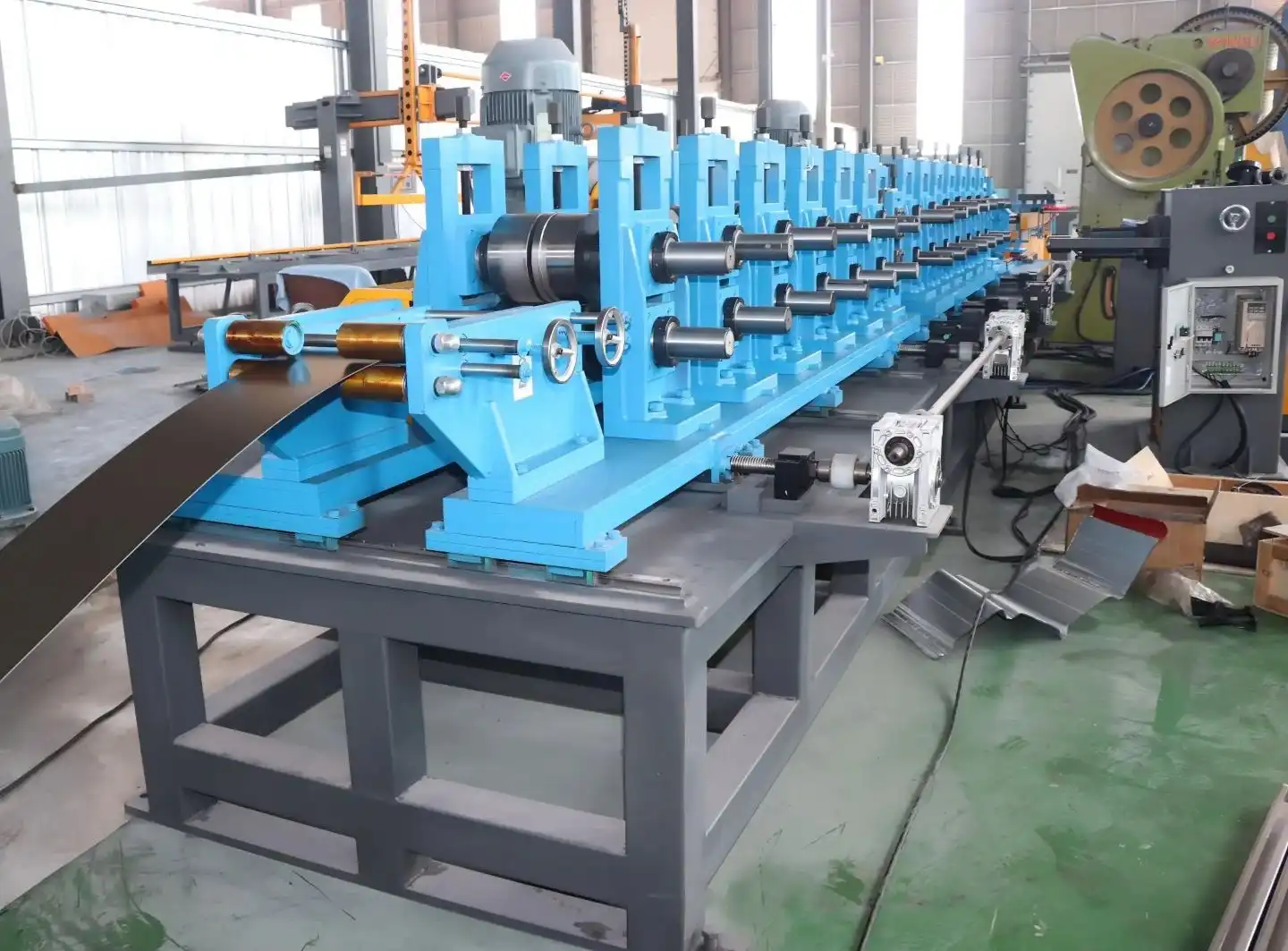
There are three main parts to the machine that work together: the roll forming section, the automatic conveying system, and the beam locking station. The ZTRFM design has 20 forming stations, each with an 80 mm solid shaft and GCr12MoV-grade rollers that have been heated to HRC 58–62. The 500H heavy-duty steel frame smooths out vibrations during heavy-load runs, and the Delta PLC control panel lets you change sizes, cut lengths, and production counts all from a single screen.
Automation vs. Manual Operation
Box sections can be formed by hand on a press brake in 4–6 minutes per beam, and at least two people are needed to do it. The fully automatic line of the box beam roll forming machine, on the other hand, moves at 15–20 m/min and only needs one person to control the shaping, moving, locking, and picking up of the final product. The PLC-controlled size adjustment system instantly moves the forming molds along the shaft. This means that it only takes minutes instead of hours to switch between beam heights that are within the planned range.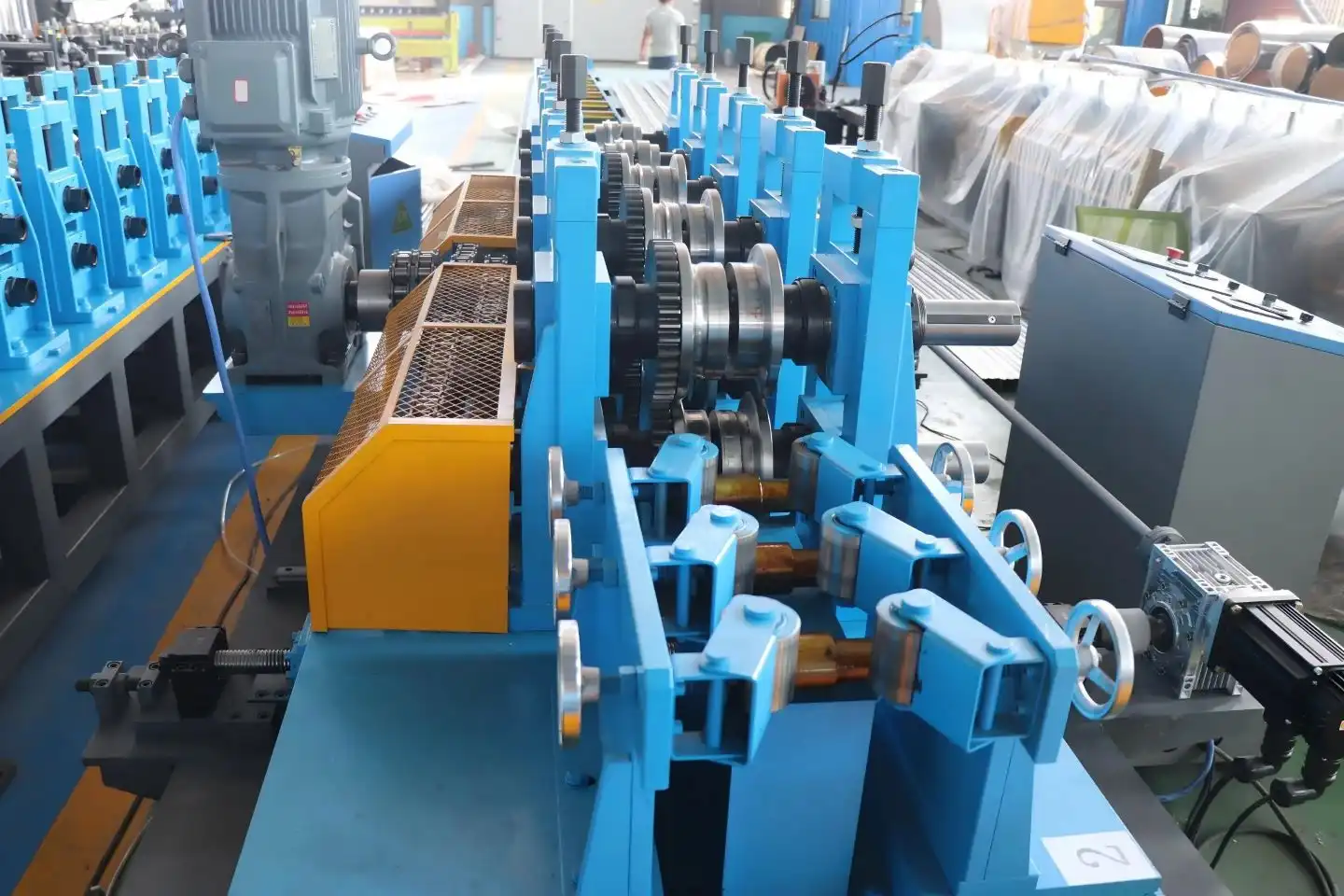
Advantages and Applications of Box Beam Roll Forming Machines
Why Manufacturers Choose Roll Forming Over Other Methods
Roll forming is the usual way to make rack beams around the world because it keeps the dimensions of large quantities of product the same. Here are the main benefits this equipment gives your factory floor:
- Speed: Line speeds of 15–20 m/min produce significantly more beams per shift than press-brake or manual welding methods.
- Precision: The GCr12MoV roller tooling holds tight dimensional tolerances, ensuring connector punch holes align accurately with upright columns — a non-negotiable requirement in pallet rack assembly.
- Labor efficiency: One operator manages the full cycle, from coil loading to finished beam stacking, cutting your per-unit labor cost substantially.
- Profile flexibility: PLC-controlled mold adjustment lets you run different beam heights without lengthy manual changeovers, supporting small-batch and high-mix production.
Two problems that keep coming up in beam manufacturing are slow output and high rejection rates due to inconsistent dimensions. These benefits directly fix these problems. If either of these problems plagues your current line, you might want to look into an automatic roll-making method.
Where These Machines Are Used
The machine was made to be used for building storage racks, but it can also be used for other things. It is used to make step beams and teardrop connector beams by rack manufacturers. It is used to make supermarket fixtures like box-section shelf support bars that can hold a lot of goods. Box beams are the main floor joists used by mezzanine builders because their closed profile resists twisting better than open sections do when the structure is loaded and unloaded quickly. In the transportation and automotive industries, rectangular hollow profiles made on similar machines are used in trailer frame parts that need to be rigid when the road shakes.
Comparing Box Beam Roll Forming Machines with Alternative Technologies
Roll Forming vs. Press Brake Bending
Because they make one bend at a time, press brakes can be used for low-volume, high-variety work. Press brakes get in the way of making thousands of rack beams every week in a plant. The operator doesn't have to move during passes on a roll-making line because it works with coil stock instead of cut sheet. Also, coil-fed roll making makes less trim scrap than sheet-fed press processes, so it gives you more material.
Roll Forming vs. Laser Cutting and Welding
Some makers try to make box beams by laser-cutting flat blanks and joining four plates together to make a rectangle. The end effect is physically sound, but it takes a long time and costs a lot. Welding causes distortions due to heat, needs to be straightened afterward, and requires skilled work. Using the box beam roll forming machine with mechanical interlocking or inline seam welding eliminates heat warping, speeds up production, and lowers the cost of consumables.
Automatic vs. Semi-Automatic Lines
Semi-automatic lines need to be moved between the making and locking stations by hand, which slows down the process and adds to the time it takes to handle things. This step is not needed at all with ZTRFM's fully automatic conveying system, so the production cycle stays going. A fully automatic setup is the best choice for buyers who care about output per shift.
How to Choose and Procure the Right Box Beam Roll Forming Machine?
Match the Machine to Your Beam Range
Before you ask for a price, you should know what shapes you want, such as the range of heights and widths for your box beams, the type of material (GI or aluminum), and the connector punch pattern your uprights need. The standard configuration of ZTRFM can work with materials that are 2.0 to 3.0 mm thick. If you use high-tensile steel at 450–550 MPa, make sure the machine has a shaft diameter of 80 mm or more and enough forming stations to handle springback without damaging the tools.
Evaluate Supplier Credentials and Certifications
In the U.S. market, buyers expect electrical systems that are UL/ETL-compliant and video acceptance tests to be done before the goods are shipped. ZTRFM is certified by ISO 9001, CE, CAS, SGS, and UL, and standard practice is to test products with videos before they are shipped. The company was started in 2014 in Botou, Cangzhou, which is China's dedicated roll-forming machinery zone. It has sent equipment to more than 150 countries, such as India's Tata Group and Korea's DS Group.
Understand Lead Times and OEM Options
Depending on how complicated the tools are, standard production wait times are 30 to 45 days. ZTRFM provides full OEM/ODM tooling under NDA for buyers who need custom connecting punch patterns or unique box-beam close designs. Steel-frame machine fixturing, moisture-protected electrical cabinets, anti-rust-coated rollers, and protective film wrapping are all examples of export packing that can be sent in normal ocean containers.
The Future of Box Beam Roll Forming Machines
Smart Controls and Remote Diagnostics
Siemens and ZTRFM have agreed to work together at a strategy level to integrate IoT devices into the cloud and use AI for remote servicing for the box beam roll forming machine. This means that data about its production, like motor loads, forming temperatures, and cut counts, can be tracked from afar, and problems can be found before they cause downtime. For buyers in North America who run operations in more than one location, remote diagnostics cut down on the number of service calls and increase uptime.
Sustainable Manufacturing Trends
When it comes to saving materials, roll forming already beats stamping and cutting. Manufacturers are now asking for steel coils with a higher recycled content, and machines need to be able to handle different quality coils without having to be adjusted all the time. The multi-layer composite forming technology that ZTRFM created with Yanshan University and the National Cold Roll Forming Institute is meant to keep the same dimensions for different amounts of material.
Industry Outlook for 2026
As the need for e-commerce operations grows, more warehouses are expected to be built around the world. In 2024, the Warehousing Education and Research Council (WERC) found that more than 60% of distribution centers they surveyed planned to add more space within the next two years. This directly affects the need for pallet rack beams and the machines that make them. Manufacturers can now get that amount since they bought a faster, more automatic beam line.
Conclusion
If you don't pick the right box beam roll forming machine for rack beam forming, it will affect your production, product quality, and costs for many years to come. ZTRFM makes fully automatic production lines that can go 15–20 m/min and have PLC-controlled size adjustment, precision connector cutting, and built-in box-beam locking. These lines are made to meet the needs of companies that make racks, grocery fixtures, and steel profile service centers. The specifications and application data in this guide will help you start your evaluation if you want to increase beam capacity or improve an existing line.
FAQ
Q1: Can this machine form high-tensile steel?
Yes. The 80 mm solid shaft and 20-station configuration handle materials up to 3.0 mm. For high-tensile grades at 450–550 MPa, confirm tooling specifications with the ZTRFM engineering team before ordering.
Q2: How does the machine join the two C-profiles without welding?
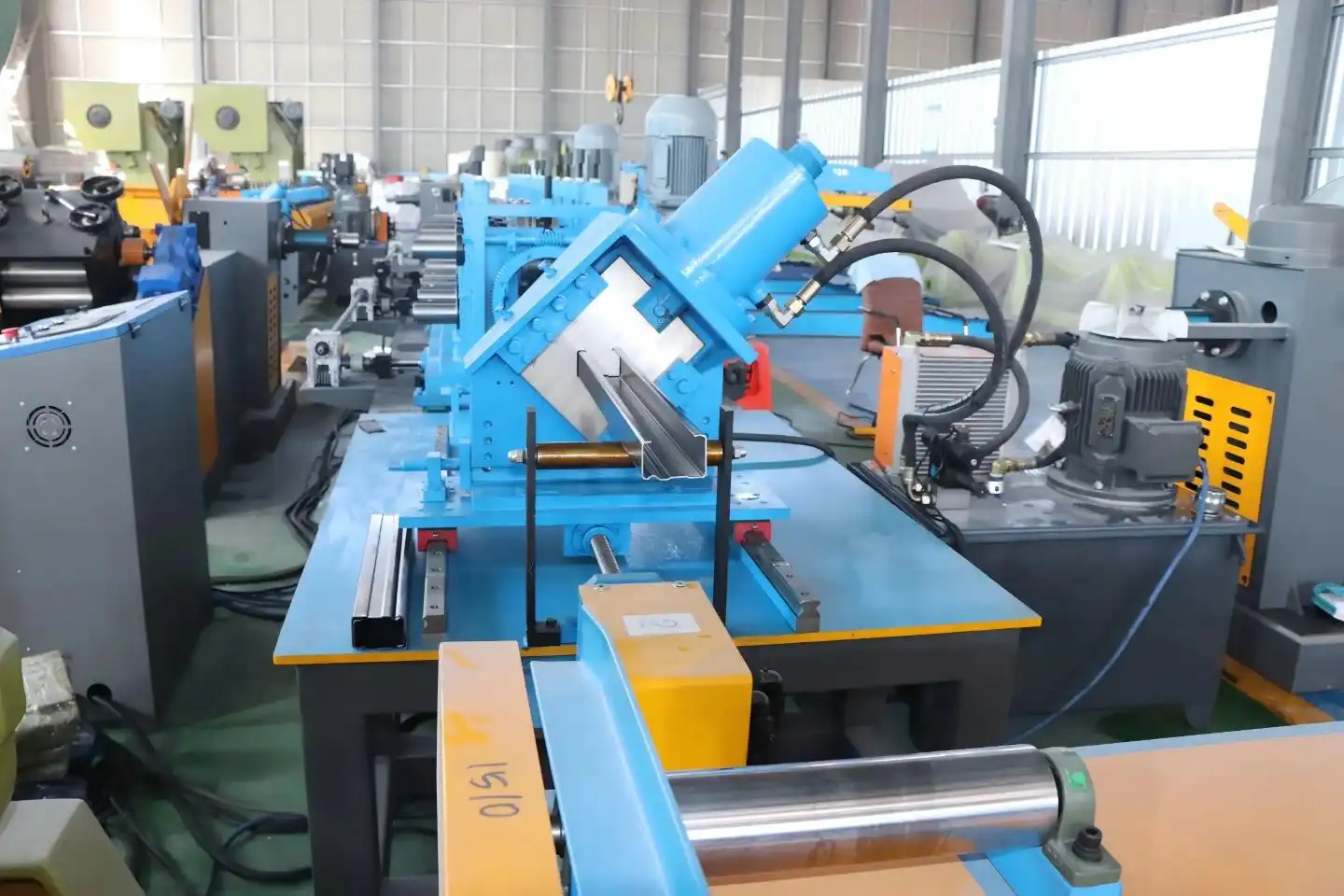
An interlocking station crimps the flanges of two formed C-profiles together mechanically. This creates a strong box section without welding consumables or heat distortion. An optional inline welding station is available for applications requiring a continuous seam.
Q3: What is the changeover time between beam sizes?
With PLC-controlled automatic mold adjustment, size changes within the designed range take approximately 10–20 minutes. No manual roller swapping is needed for height adjustments within the configured forming range.
Q4: What maintenance does the cutting system require?
The Cr12MoV flying shear blades are recommended for sharpening after approximately 100,000 cuts. Monthly checks of hydraulic oil cleanliness and blade clearance keep wear rates low and cut quality burr-free.
Request a Quote from ZTRFM — Box Beam Roll Forming Machine Supplier
ZTRFM makes fully automatic box beam roll forming machine rack beam production lines with approved quality, OEM/ODM tools, and prices that come straight from the plant. Our machines are certified by ISO 9001, CE, UL, and CAS and are used in more than 150 countries. The engineers at our company can help you whether you need a normal line or a custom design that fits your upright punch pattern. To get prices and details, email us at zhongtuorollforming@gmail.com right now.
References
1. Peko, J. & Šarić, T. — International Journal of Advanced Manufacturing Technology, 2021.
2. Halmos, G. T. — Roll Forming Handbook, CRC Press, 2006.
3. Warehouse Education and Research Council (WERC) — DC Measures Annual Report, 2024.
4. American Iron and Steel Institute (AISI) — Steel Products Manual: Hot-Rolled Carbon Steel Sheet and Strip, 2022.
5. Rack Manufacturers Institute (RMI) — Specification for the Design, Testing and Utilization of Industrial Steel Storage Racks, 2021.
6. European Cold Rolling Association — Cold Rolled Steel in Construction Applications, Eurofer Technical Report, 2023.