- English
- French
- German
- Portuguese
- Spanish
- Russian
- Japanese
- Korean
- Arabic
- Irish
- Greek
- Turkish
- Italian
- Danish
- Romanian
- Indonesian
- Czech
- Afrikaans
- Swedish
- Polish
- Basque
- Catalan
- Esperanto
- Hindi
- Lao
- Albanian
- Amharic
- Armenian
- Azerbaijani
- Belarusian
- Bengali
- Bosnian
- Bulgarian
- Cebuano
- Chichewa
- Corsican
- Croatian
- Dutch
- Estonian
- Filipino
- Finnish
- Frisian
- Galician
- Georgian
- Gujarati
- Haitian
- Hausa
- Hawaiian
- Hebrew
- Hmong
- Hungarian
- Icelandic
- Igbo
- Javanese
- Kannada
- Kazakh
- Khmer
- Kurdish
- Kyrgyz
- Latin
- Latvian
- Lithuanian
- Luxembou..
- Macedonian
- Malagasy
- Malay
- Malayalam
- Maltese
- Maori
- Marathi
- Mongolian
- Burmese
- Nepali
- Norwegian
- Pashto
- Persian
- Punjabi
- Serbian
- Sesotho
- Sinhala
- Slovak
- Slovenian
- Somali
- Samoan
- Scots Gaelic
- Shona
- Sindhi
- Sundanese
- Swahili
- Tajik
- Tamil
- Telugu
- Thai
- Ukrainian
- Urdu
- Uzbek
- Vietnamese
- Welsh
- Xhosa
- Yiddish
- Yoruba
- Zulu
Commercial Rooftop Solar Mounting: Line Selection
When choosing a manufacturing line for commercial rooftop solar installation, it is necessary to ensure that the machine is compatible with your profiles, steel thickness, hole patterns, and output. Because it transforms coil into straight, repeatable C-channels and mounting rails in a single continuous run, a solar strut channel roll forming machine is an ideal tool for this kind of job. Start with your profile drawings and coil specifications. Compare automation, production speed, and total cost of ownership. One last thing to do is investigate the testing, documentation, and after-sales assistance offered by the provider. In order to take you through each step, I will be using the specs of the ZTRFM line in this tutorial.
Define Your Rooftop Production Requirements Start with Profiles and Drawings
C-channels, U-channels, slotted struts, and mounting rails are used in the construction of commercial rooftop projects. It is necessary to have a unique roll tooling, guide, and punching plan for each form. It is highly recommended that you begin by gathering your designs, which should include tolerances, dimensions, hole spacing, and cut lengths. As a result of the fact that your designs should already reflect that technical input, rooftop designers size channels to accommodate wind and snow loads that are specified by ASCE/SEI 7-22. Through the use of fast roll change or servo adjustment, our line is capable of forming sizes such as 4141, 4121, and 4162. To ensure that our engineers are able to examine the roll pass design, please provide drawings in either DXF, DWG, or PDF format.
Size the Capacity Plan
The monthly volume, shifts, coil changes, and anticipated growth should all be accounted for in the output planning process. At a rate of 8 meters per minute, our equipment is capable of producing 480 meters in a single hour of continuous formation. Consider that number to be a ceiling, and then deduct it from the total amount for punching pauses, cutting, and coil changes. A store that caters to roofing contractors in the area could discover that this pace is suitable for its volume. If they export a lot of goods, they could need two lines. You should write out your goal meters per shift as early as possible since doing so helps to keep the discussion of quotations reasonable.
Match Material and Coating
Galvanised or pre-galvanized coil is used in the majority of rooftop channels. The coating designations for zinc-coated sheet are defined by ASTM A653, such as G90; thus, you should identify the designation in your request for quotation. Material with a thickness ranging from 1.5 to 2.5 millimetres may be processed by our equipment, which has a feeding width ranging from 90 to 230 millimetres. For the purpose of protecting the zinc surface while it is being formed, the forming rollers are made of GCr15 steel that has been plated with chrome. It is necessary to check the complete grade and thickness range, rather than just one nominal figure, since steel that is thicker or has a greater strength requires more effort to form. Please inform us at the beginning of the process if you want to run stainless steel, since this may affect the requirements for tooling and drives.
How a Solar Strut Channel Roll Forming Machine Works
The Process from Coil to Stack
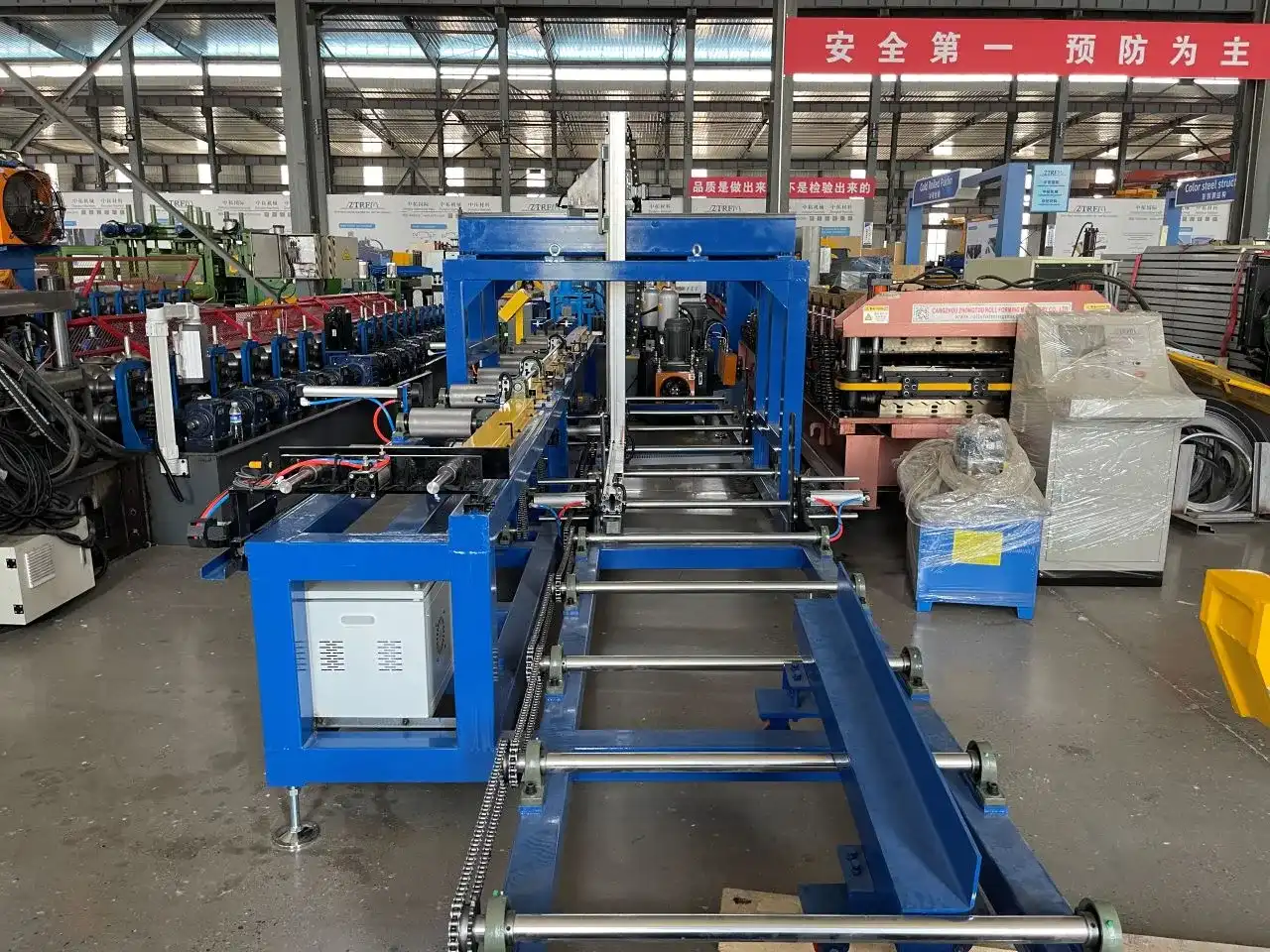
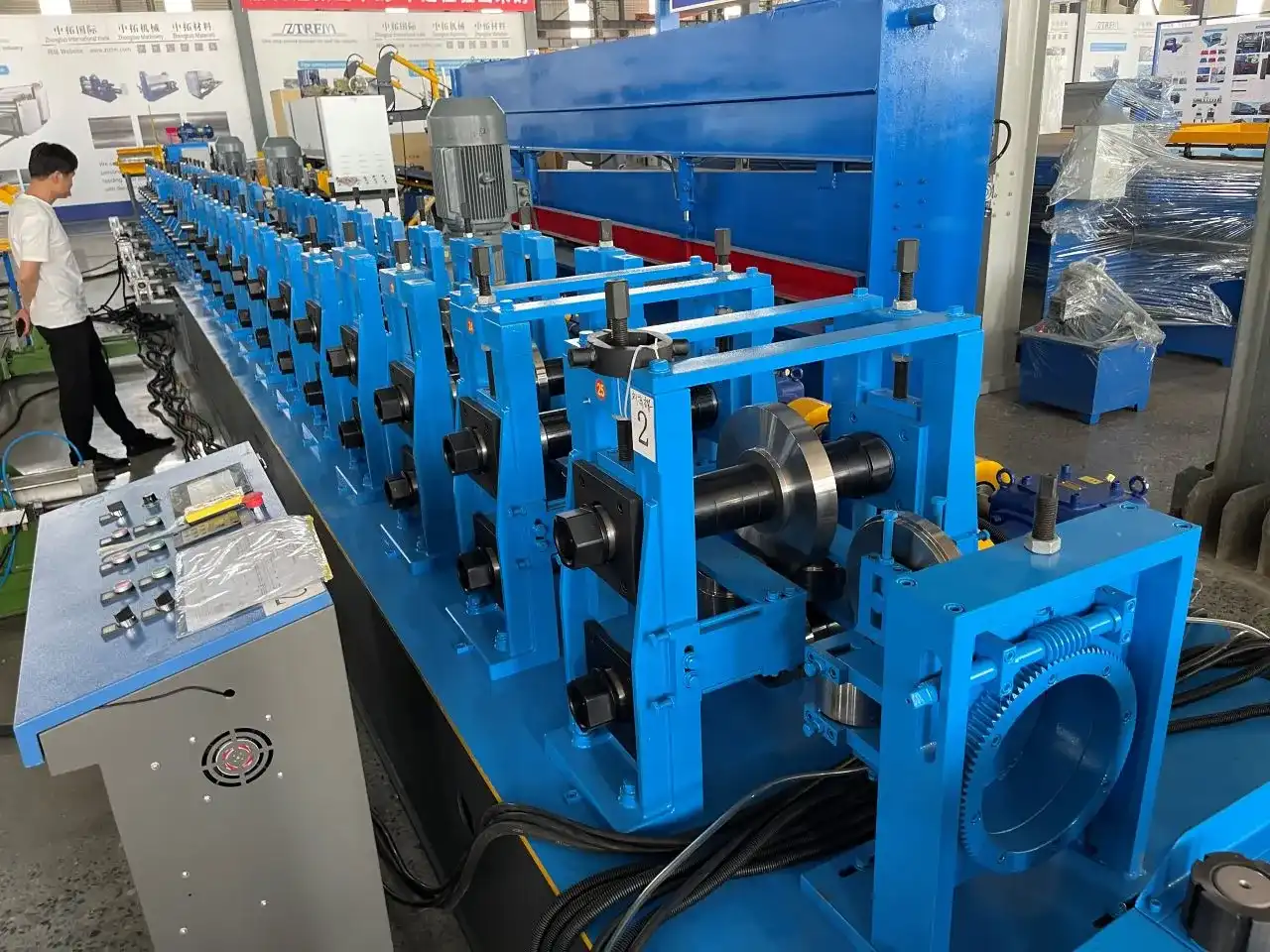
The ZTRFM solar strut channel roll forming machine runs in a continuous sequence from decoiling and levelling through punching, forming, cutting, and stacking. Prior to the strip entering the forming area, the punch is used to create slot holes, and the leveller is responsible for removing the coil set. Rolls then bend the strip in a series of progressive stages until the channel takes its final shape, which is a concept that George Halmos discusses in his Roll Forming Handbook. Operators are able to monitor output at a glance thanks to a programmable logic controller (PLC) with a touchscreen for length settings, piece counts, and alarms. The shear cuts the finished channels to length before they are stacked.
Core Specifications of Our Line
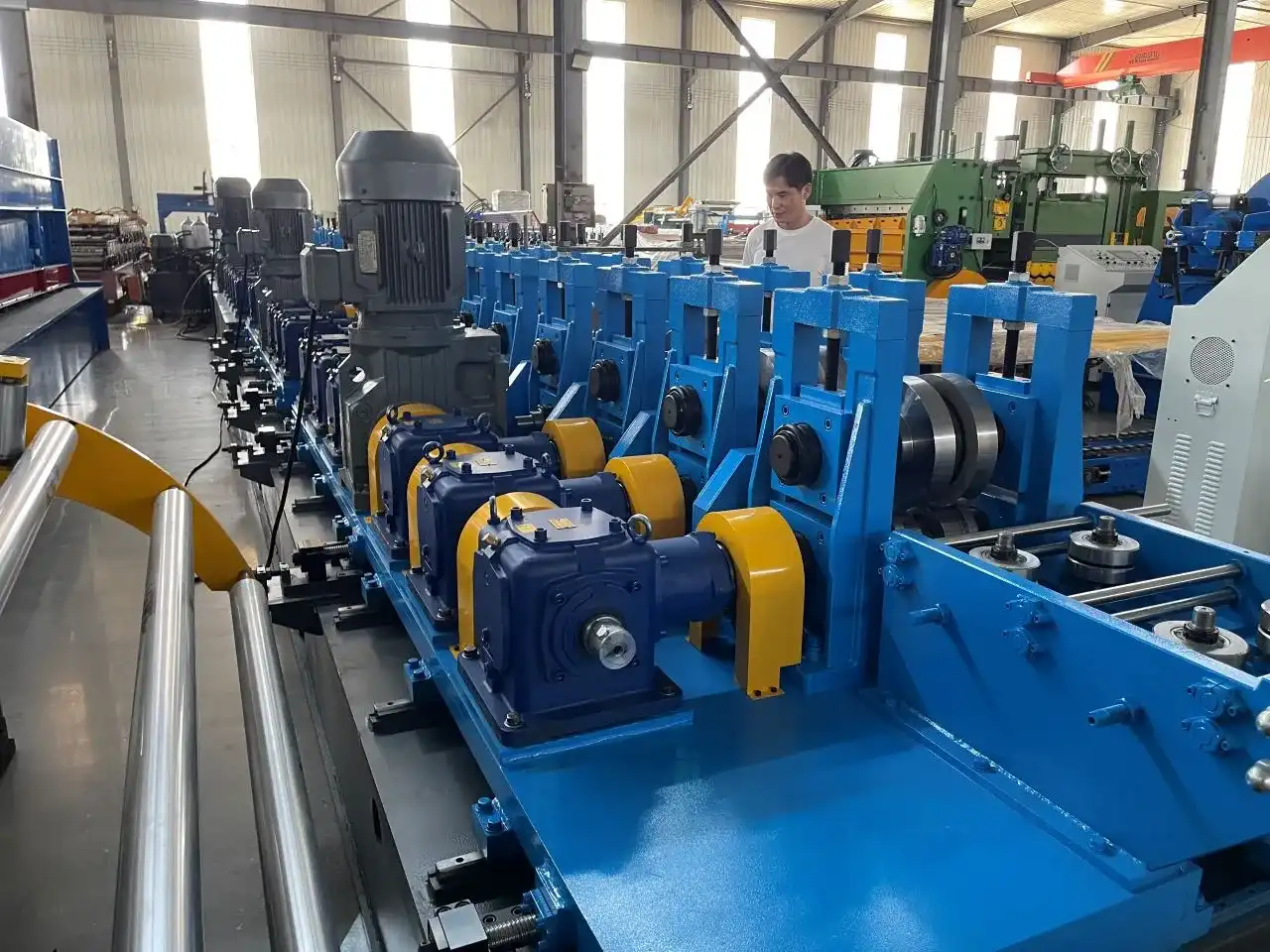
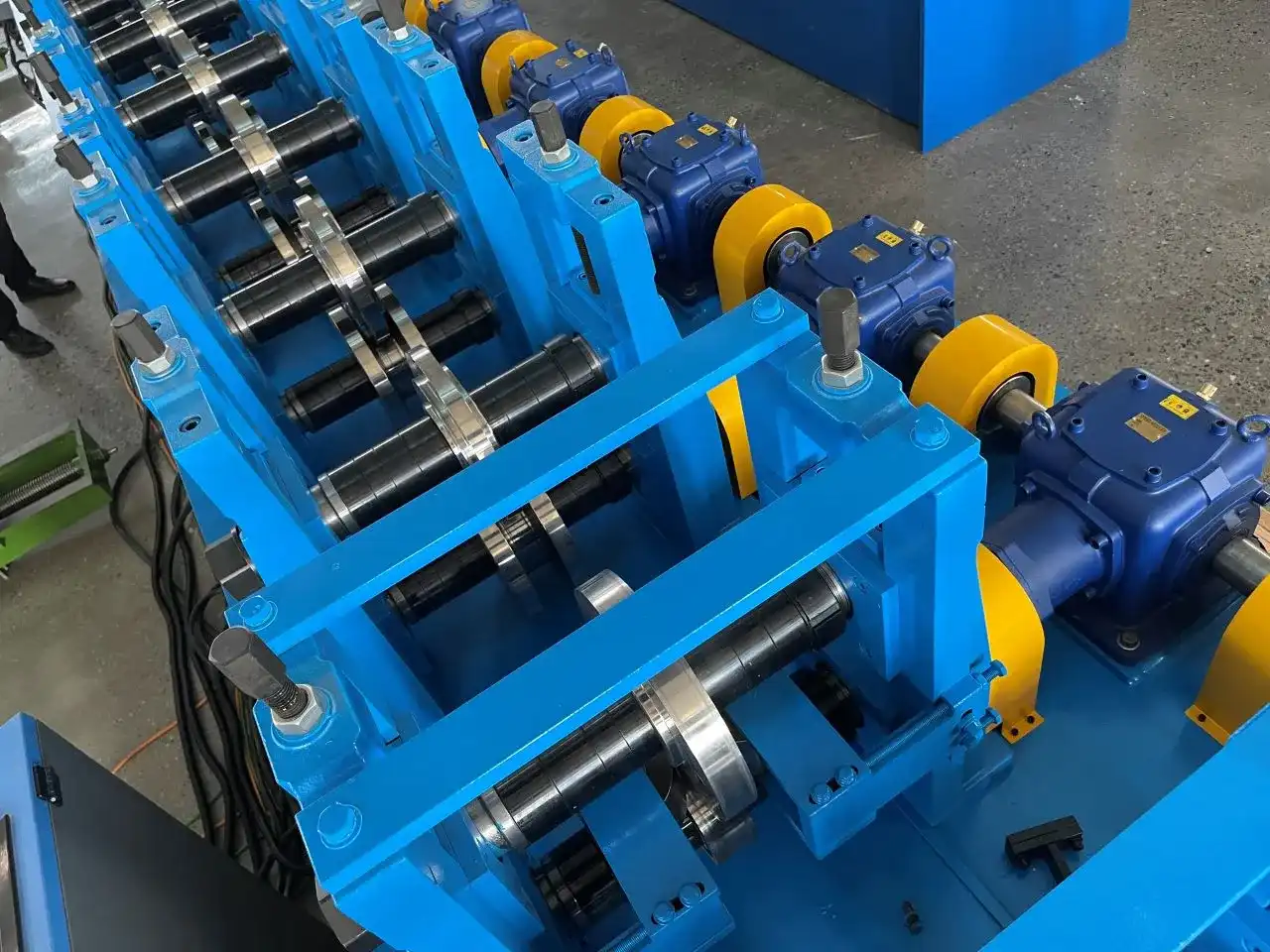
The ZTRFM line has a 22 kW main motor and an 11 kW hydraulic station that powers the shear. The body of the line is constructed out of 25 mm 45# steel, and it is equipped with 24 rollers that are mounted on 80 mm shafts manufactured from 45# forged steel. Using double chains, the stands are driven. Cr12 mould steel that has been quenched to 58–62 HRC is used to make cutter blades. The stated tolerance is ±1.5 mm. In addition to the standard voltage of 380V, three-phase, 50Hz, clients have the option of requesting different voltages. Before placing a purchase, customers in the United States should verify their local supply.
Roll Forming vs. Press Braking
As a result of the continuous movement of the strip and the fact that punching and cutting take place in the same line, roll forming is often the method of choice for lengthy, repeating profiles. The process of roll forming is described by Kalpakjian and Schmid as being particularly well-suited to the manufacturing of lengthy parts with a consistent cross-section in large volumes. The use of press brakes is still appropriate for prototypes, small batches, or forms that are constantly altered; nevertheless, the amount of time required for handling and operator time per piece is increased. Punching may be done online, by push, or offline with our line, allowing you to begin with a smaller capacity and then increase it later. Not by habit, but by volume and repeat orders, make your selection.
Choose Automation, Speed, and Cost
Automatic or Semi-Automatic
The processes of decoiling, levelling, punching, shaping, cutting, and stacking are aggregated into a single regulated flow by use of automatic lines. Handling is reduced as a result, and hole placements are maintained uniformly. Semi-automatic setups are more suitable for firms that pack by hand, have smaller quantities, or experience frequent changes. They also have a cheaper initial cost. Analyse the number of operators required by each choice, the degree of accuracy of the feed, and the amount of time required to adjust the size. Whether it be a Siemens or Mitsubishi PLC, our range is equipped with a touchscreen. When it comes to bulk production, I recommend using online punching, whereas press punching is best for intricate hole patterns. Offline punching is recommended for smaller bespoke batches.
Check Real Speed and Quality
The actual output is seldom the same as the rated speed. Hole count, cut length, variations in coil, and thickness are all factors that slow down the line. Request a test run using your own profile and coil, and then evaluate the outcomes of the experiment. We have a forming speed of 8 meters per minute, with a tolerance of ±1.5 millimetres. On the sample pieces, examine the dimensions of the cross-section, the hole spacing, the cut length, the burrs, the straightness, and the condition of the coating. As an alternative to interpreting the 22 kW and 11 kW ratings on their own, you should calculate the energy cost per completed meter. Make sure that the findings of the factory acceptance test are documented in writing by requesting it before shipping.
Build a Cost and ROI Comparison
Start with the purchase price of the solar strut channel roll forming machine. Tooling, electricity, hydraulic oil, maintenance, replacement parts, downtime, packing, installation, and training are all additional expenses that must be accommodated. Divide annual operating costs by the expected annual output in finished meters. Compare that cost per meter with what you pay for outsourced channels or what your current line costs to run. As an indication of the magnitude of the need for racking, SEIA and Wood Mackenzie reported that the United States added around 40 GWdc of solar capacity in 2023. Make sure that your estimates are based on actual utilisation rather than the best-case scenario.
Choose the Right Supplier and Configuration
Check Supplier Credentials
Examine the individuals who are in charge of engineering, manufacturing, testing, and user support. With ISO 9001, CE, and CAS certifications, Cangzhou Zhongtuo is a company that was established in 2014 and specialises in the design and construction of cold roll forming equipment. In addition to providing OEM and ODM services, as well as raw materials, equipment, and accessories, our machines are now in operation in more than 150 countries. Request that any potential supplier provide you with design layouts, electrical schematics, roll design data, test footage, manuals, and lists of replacement parts. On-site installation and training, remote troubleshooting with software upgrades, and a rapid supply of replacement parts are all included in our support services.
Prepare a Complete RFQ
An RFQ that is explicit will create quotations that can be compared. Include the following information: final lengths, goal output, voltage, frequency, and floor space; profile drawings; material grade; thickness; coil width; hole shapes and spacing; surface area; and coil width. Request that each provider provide information on the punching accuracy, cut-length tolerance, tooling material, changeover technique, machine footprint, delivery time, installation scope, and replacement parts that are provided. 380V, three-phase, 50Hz is our standard voltage; thus, you should indicate your supply as early as possible so that the electrical design may be adjusted accordingly. When all of the responses are compiled into a single table, it is much simpler to identify any variations in the conditions of the shipment, testing, and warranty.
Match Configurations and Avoid Mistakes
A semi-automatic decoiler, one forming machine, hydraulic cutting, and basic PLC control are all things that might be required for a small business to get started. Automatic decoiling, online punching, and stacking are all features that are added by high-volume providers. Tools with several profiles and a variety of hole designs are often requested by OEM customers. There are three common errors that people make: purchasing it at the lowest possible price, accepting the rated speed without first undergoing a test, and bypassing operator training. Later occurrences of downtime are also caused by undersized frames and poor tooling. Our frame is constructed out of steel measuring 25 millimetres, and its modular design allows for improvements and future growth. Share your future profiles with us right now so that the queue can expand to accommodate your orders.
Conclusion
Clear profile drawings, a specified material and coating, and a realistic output objective are the first steps in the process of selecting a line for commercial rooftop solar installation. A solar strut channel roll forming machine is well suited to long, repetitive channels. The automation level should be determined by the volume, the intricacy of the hole, and the amount of labour. It is necessary to verify the rated speed via testing, and the cost per completed metre provides a more accurate comparison than the pricing of the machine. In order to demonstrate how requirements translate into everyday production, the ZTRFM line has a thickness range of 1.5–2.5 mm, a speed of 8 meters per minute, 24 rollers, and three alternatives for punching. The selection is finished when the supplier provides documentation, testing, voltage matching, and support, and a clear request for quotation makes comparisons easy to make.
FAQ
1. Can one line produce different strut sizes?
Indeed. Through the use of rapid roll change or servo adjustment, our design is capable of forming shapes such as 41×41, 41×21, and 41×62. It is important to verify your measurements before placing an order since the restrictions are determined by the range of 90–230 mm feeding width and 1.5–2.5 mm thickness.
2. Which punching option should I choose?
The offline punching method is suitable for small or bespoke batches, while the online punching method is suitable for bulk production. Press punching is able to handle intricate hole patterns. Depending on your hole layout and monthly volume, the optimal match will be determined.
3. What should I send to receive a quotation?
Drafts of the profile, the material grade and thickness, the hole spacing, the cut length, the desired output, and the voltage requirements should be sent. After reviewing them, our engineers provide a recommendation for a configuration that includes a layout and a specification sheet.
Request Your Solar Strut Channel Roll Forming Machine Quote from ZTRFM
Our engineers will provide a recommendation for a line that is suitable for your profiles if you send your designs and production objectives to ZTRFM at the email address zhongtuorollforming@gmail.com. For your solar strut channel roll forming machine, ZTRFM offers OEM and ODM design, 24-roller forming, hydraulic shearing, installation support, and spare parts. Please share your thickness, hole pattern, and voltage requirements with us right away.
References
1. SEIA and Wood Mackenzie, U.S. Solar Market Insight 2023 Year in Review, 2024
2. American Society of Civil Engineers, Minimum Design Loads and Associated Criteria for Buildings and Other Structures (ASCE/SEI 7-22), 2022
3. ASTM International, ASTM A653/A653M Standard Specification for Steel Sheet, Zinc-Coated (Galvanized) or Zinc-Iron Alloy-Coated (Galvannealed) by the Hot-Dip Process, 2022
4. Halmos, G. T., Roll Forming Handbook, 2005
5. Kalpakjian, S. and Schmid, S., Manufacturing Engineering and Technology, 2014
6. National Renewable Energy Laboratory, U.S. Solar Photovoltaic System and Energy Storage Cost Benchmarks, 2023