- English
- French
- German
- Portuguese
- Spanish
- Russian
- Japanese
- Korean
- Arabic
- Irish
- Greek
- Turkish
- Italian
- Danish
- Romanian
- Indonesian
- Czech
- Afrikaans
- Swedish
- Polish
- Basque
- Catalan
- Esperanto
- Hindi
- Lao
- Albanian
- Amharic
- Armenian
- Azerbaijani
- Belarusian
- Bengali
- Bosnian
- Bulgarian
- Cebuano
- Chichewa
- Corsican
- Croatian
- Dutch
- Estonian
- Filipino
- Finnish
- Frisian
- Galician
- Georgian
- Gujarati
- Haitian
- Hausa
- Hawaiian
- Hebrew
- Hmong
- Hungarian
- Icelandic
- Igbo
- Javanese
- Kannada
- Kazakh
- Khmer
- Kurdish
- Kyrgyz
- Latin
- Latvian
- Lithuanian
- Luxembou..
- Macedonian
- Malagasy
- Malay
- Malayalam
- Maltese
- Maori
- Marathi
- Mongolian
- Burmese
- Nepali
- Norwegian
- Pashto
- Persian
- Punjabi
- Serbian
- Sesotho
- Sinhala
- Slovak
- Slovenian
- Somali
- Samoan
- Scots Gaelic
- Shona
- Sindhi
- Sundanese
- Swahili
- Tajik
- Tamil
- Telugu
- Thai
- Ukrainian
- Urdu
- Uzbek
- Vietnamese
- Welsh
- Xhosa
- Yiddish
- Yoruba
- Zulu
Why straightness matters most on a ceiling t bar machine?
On any ceiling t bar machine, straightness is not a cosmetic detail — it is a production-critical specification. When a T-bar profile deviates even 1 mm over a 3,600 mm length, ceiling tiles shift, cross tees refuse to click into place, and installation crews spend hours correcting what should have been a factory problem. I have seen projects in commercial offices and retail malls where warped main tees caused visible ceiling sag, triggered rework costs, and delayed handovers. Getting straightness right at the machine level is the single most effective way to avoid those downstream failures.
Understanding Straightness in Ceiling T Bar Production What Straightness Actually Means in Roll Forming
When a finished T-bar shape comes out of the roller stations, how closely it follows a true linear axis is called its straightness. In real life, this means that the profile must not have any side bows, vertical cambers, or twists along its whole length. For suspended ceiling grids, the acceptable range is usually within 1 mm per 3,600 mm section. This is based on ASTM C635 for load-bearing ceiling suspension systems.
How Machine Components Control Profile Geometry
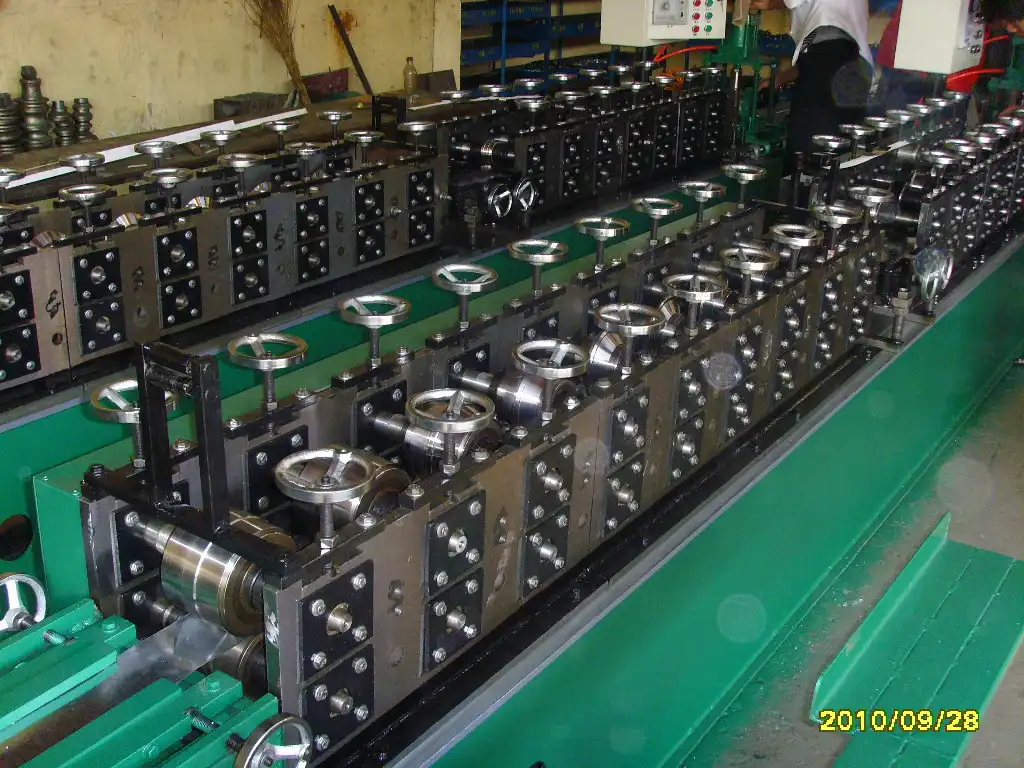
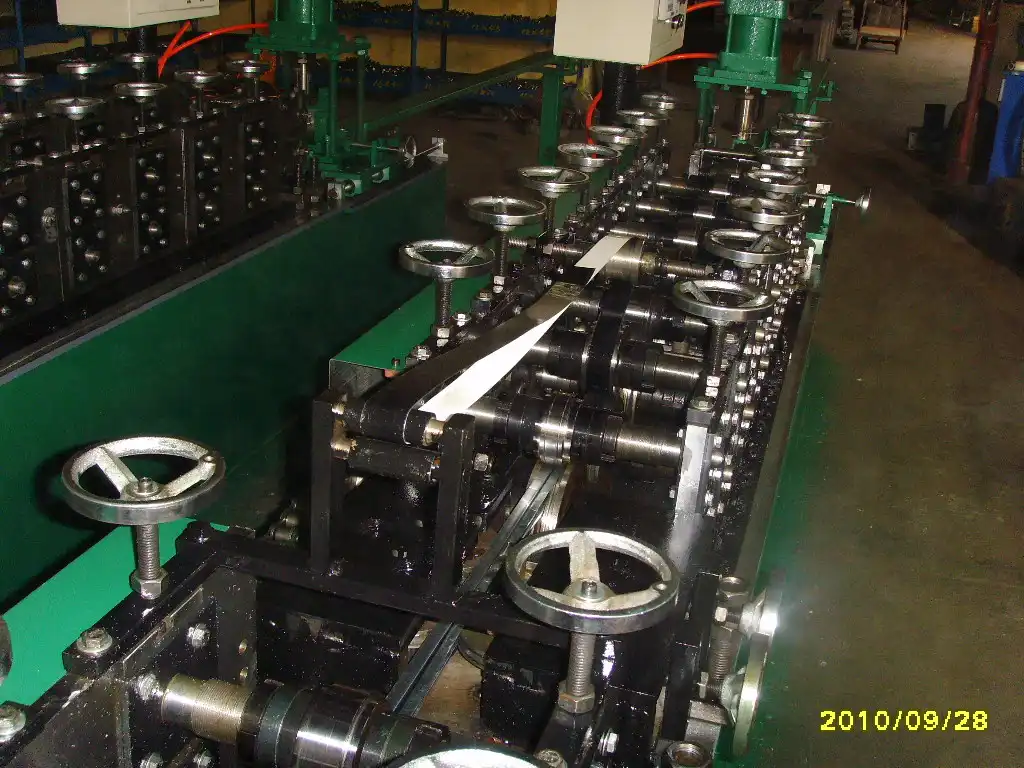
Three systems work together to keep a roll-making line straight: the roller stations, the straightening guides between stations, and the cutting device at the exit. GB-Cr12 steel rollers are used in 18 stations for the main tee and 16 stations for the cross tee on our line. At each station, a controlled incremental bend is made to the strip. If any station is out of place or worn, the total mistake shows up in the final profile as a bow or twist.
The Role of Material Thickness in Straightness
On a ceiling t grid machine, the choice of raw material has a direct effect on how well a profile keeps its shape. For the T-bar top cap, we use PPGI at 0.12–0.3 mm and GI at 0.2–0.4 mm. Roller pressure changes can be felt more clearly in gauges that are thinner. Even a small difference in the thickness of the coil across its width can make a shape that looks straight at the station but bends after cutting when the internal stress goes away.
Why Straightness Is Critical: Impact on Performance and Quality
Installation Efficiency on the Job Site
Cross tees are clipped into main tees all at once by installation crews when T-bar sections arrive straight. When profiles bow by as little as 1.5 mm, workers have to force connections to stay in place, which puts stress on the grid. As per information released by ASTM International, industrial ceiling suspension system breakdowns are often caused by non-conforming profile geometry rather than hardware problems.
Compliance With Building Codes and Standards
In the United States, ASTM C635 and ASTM C636 specify the size ranges for parts of suspended ceilings. When makers send out-of-tolerance T-bars, they risk product liability lawsuits and inspection failures. In seismic zones, straightness compliance is required because the grid has to be able to handle sideways movement without buckling. This means that every profile the machine makes has to have the same cross-sectional geometry.
Long-Term Ceiling Appearance and Client Satisfaction
The ceiling grid will move when it is put up on the first day if the T-bars have internal bow stress. That stress slowly goes away when the temperature changes, and the gaps between the tiles start to look uneven. One project complaint about the look of the ceiling can ruin a distributor's brand relationship with a network of contractors who use their private-label products.
Common Causes of Straightness Issues and How to Prevent Them
Mechanical Wear on Rollers and Guides
On a ceiling t bar machine, rollers made of lower-quality steel wear out randomly after a lot of use. When roller faces are worn, they put uneven pressure on the width of the strip. This makes the profile consistently lean to one side. Our GB-Cr12 rollers are made with heat treatment and chrome plating, which makes them last much longer than normal tool steel rollers.
Poor Coil Quality and Inconsistent Strip Width
Problems with straightness start before the strip even gets to the first roller station. Coils with different thicknesses, too much slope from the steel mill, or different widths run through the decoiler in an uneven way. Our decoiler can handle coils weighing up to 1.5 tons and having an inner diameter of 450–550 mm. It uses a 45# steel rolling shaft with a 50 mm diameter to keep the feeding tension stable throughout the coil.
Calibration Gaps and Operator Errors
Many mistakes happen because the gap between the roller passes is not set correctly. This is especially common in the first four to six stations, where most of the profile shape is formed. When operators don't calibrate after changing tools, they cause drift that can't be seen until after several hundred meters of production, by which time a lot of scrap has been made. We suggest that you get calibrated on a regular basis after every coil change and every time you switch out tools.
Optimizing Straightness: Best Practices and Machine Features
Choosing the Right Technical Specifications
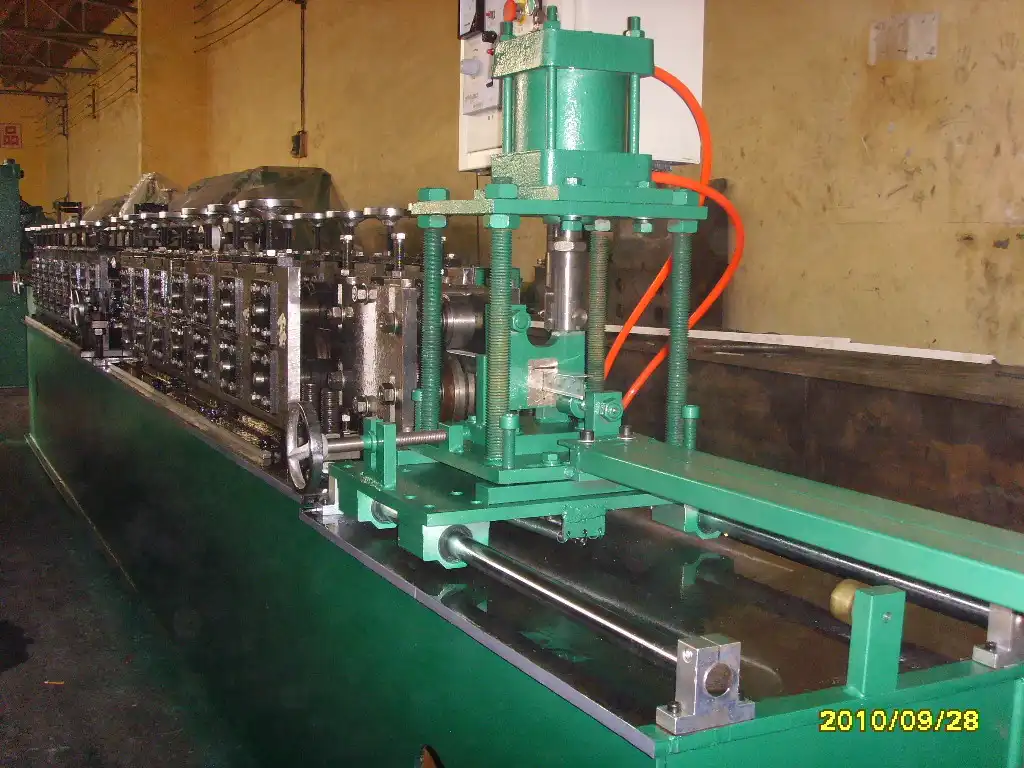
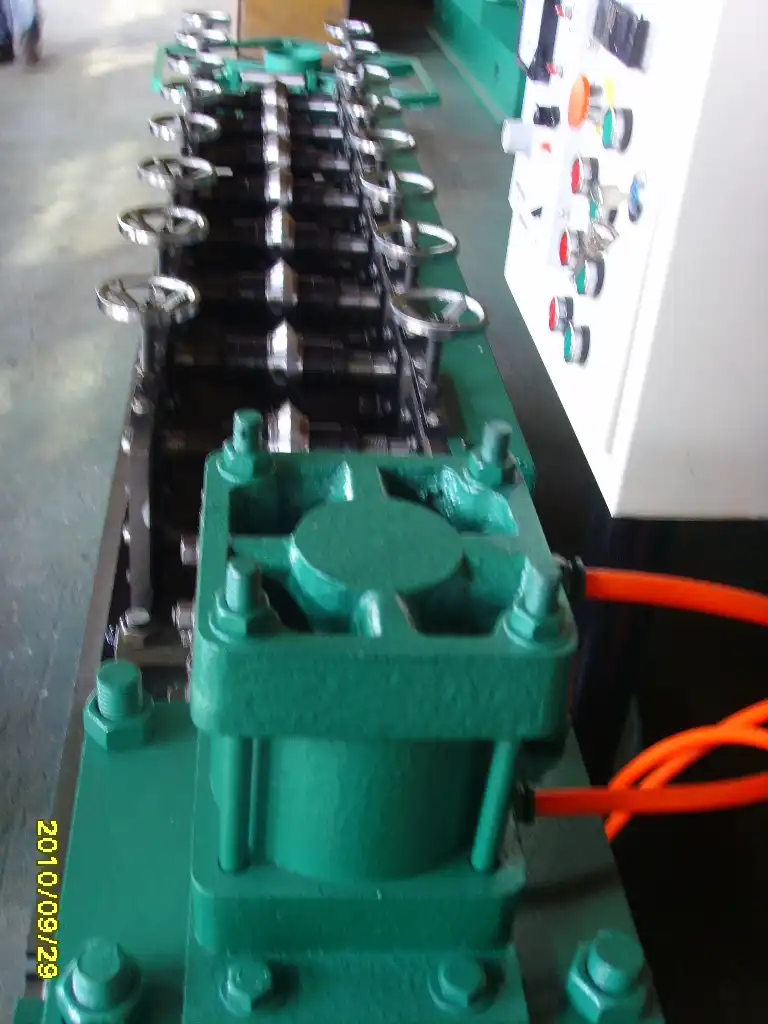
When looking at a suspending ceiling forming line, buyers should compare three things that are directly related to how straight the line is: the cutting method, the number of forming stations, and the type of material used for the rollers. Flying hydraulic cut systems keep the shape of the profile at the cut end, but stop-start shearing can make the end flare, which makes the clip connection less reliable.
Here are the most important technical details that buyers should look over before making a purchase:
- Roller material: GB-Cr12 with heat treatment and chrome plating prevents surface wear and profile marking on PPGI surfaces.
- Station count: 18 stations for the main tee and 16 for the cross tee allow gradual, low-stress forming that reduces springback.
- Work speed: 0–20 m/min with inline punching and cutting maintains dimensional consistency without sacrificing throughput.
- Decoiler capacity: 1.5-ton loading with 450–550 mm inner diameter accommodates standard commercial coil sizes.
For a full production shift, these specs directly show how well the machine stays within its straightness tolerance. The most common causes of profile deviation are taken care of before they reach the cutting station by a line that meets all four points.
Automation and Servo-Driven Corrections
Adjusting the roller gap by hand requires skill and attention, which can be different between shifts. Servo-driven feed systems keep the strip tension the same even if the coil diameter changes while it's being unwound. Our lines are linked to Siemens' cloud IoT and AI remote repair systems. These systems watch motor power and hydraulic pressure in real time and alert us to any changes before they affect the shape of the profile.
Maintenance Routines That Protect Straightness
For a ceiling t grid machine, since straightness gets worse over time, maintenance plans need to be proactive instead of reactive. It is suggested that the condition of the roller surfaces be checked every 500,000 meters of production, the clearances between the guide plates be checked every time the coils are changed, and the punching dies be replaced every 100,000 strokes, as tracked by the PLC stroke counter. When these steps are regularly taken, profile variation stays within the tolerance of 1 mm per 3,600 mm that is needed for business ceilings.
Straightness and Procurement Decisions for B2B Buyers
Comparing Machines by Straightness Performance
When looking for a ceiling grid forming line, business-to-business buyers should ask for a flat-table laser check report as part of the plant acceptance test. A reliable maker will show proof that the variation of the 3,600 mm main tee stays within 1 mm. As well as a short example, buyers should also ask for an 8-hour full-load movie to make sure that the straightness stays the same during the whole production run.
OEM and Custom Tooling Options
OEM tools that are precisely matched to a manufacturer's flange width and web height are helpful for those who run private-label programs or make custom grid shapes. To make custom dimple patterns, slot spacing, and end-clip configurations, the tools need to be very precise, which has an effect on how the profile comes out of the last forming station. When the tooling is made to fit the profile geometry instead of being taken from a standard set, the straightness tolerances get smaller.
Evaluating After-Sales Support and Warranty
How straight a machine stays over its lifetime depends on how well spare parts are made and how quickly technical support is provided. Buyers should make sure that roller sets, punching dies, and guide components can be replaced and that the provider offers tests that can be done from afar. Our active deployments in more than 150 countries and ISO 9001, CE, and CAS certifications give procurement teams a track record they can check before signing a purchase order.
Conclusion
For a ceiling t bar machine, when making T-bars, straightness is an area where machine accuracy directly affects results on the job site. If you make sure your forming line has the right roller material, the right number of stations, stable feeding tension, and consistent measurements, the profile shape will stay within the tolerances for millions of meters of production. This level of consistency protects the quality of the products, cuts down on complaints about installation, and keeps inspection records clean for those who make, distribute, and build prefab homes. When costs for rework and rejected batches are taken out of the equation, the money spent on a well-engineered line pays for itself very quickly.
FAQ
Q1: How often should I calibrate the roller stations to maintain straightness?
Every time you change the coils or the tools, you should check the roller gaps. A full station check should be done once a week on high-volume lines that have more than one shift per day.
Q2: What raw material quality best supports straight profile output?
Use PPGI coils that have the same thickness tolerance across the whole width of the strip. For the T-bar top cap, 0.12–0.3 mm PPGI with a tight mill camber error lowers the amount of sideways movement as it goes through the making stations. For the bottom plate, 0.2–0.4 mm GI with a fixed yield strength stops the springback from changing.
Q3: Does work speed affect straightness on the forming line?
Yes. When inline punching at speeds above 20 m/min, timing the pressure is very important. Our standard lines move at 0–20 m/min and punch and cut to keep the sizes under control. Servo-driven systems can change speeds without changing the straightness of the system.
Q4: Can automation features replace manual roller adjustments entirely?
Servo feed and IoT tracking make human work much less common, but they don't take the place of checking the gaps and inspecting the rollers physically. Automation finds deviations early on, and maintenance fixes the problem at its source.
Get a Ceiling T Bar Machine Quote From ZTRFM Today
ZTRFM makes ceiling T-bar machine lines that stay straight at 1 mm every 3,600 mm during full production shifts. Our factory in Botou, Cangzhou, is ISO 9001, CE, and CAS certified, and we've sold forming lines to Tata Group, DS Group, and people in over 150 other countries. To get specifications, samples, or a custom OEM tooling quote from a ceiling t bar machine manufacturer with a decade of proven production results, email our team at zhongtuorollforming@gmail.com.
References
1. ASTM International. ASTM C635: Standard Specification for the Manufacture, Performance, and Testing of Metal Suspension Systems for Acoustical Tile and Lay-In Panel Ceilings. 2022.
2. ASTM International. ASTM C636: Standard Practice for Installation of Metal Ceiling Suspension Systems for Acoustical Tile and Lay-In Panels. 2021.
3. The Fabricator. Roll Forming Fundamentals: Controlling Camber and Bow in Light-Gauge Profiles. 2020.
4. Sheet Metal Industries. Roller Wear and Its Effect on Profile Geometry in Continuous Roll Forming Lines. 2019.
5. Steel Construction Institute. Design of Light Gauge Steel Framing Systems for Interior Applications. 2021.
6. Modern Metals. Quality Control in Suspended Ceiling Component Manufacturing: Dimensional Tolerances and Testing Methods. 2022.