- English
- French
- German
- Portuguese
- Spanish
- Russian
- Japanese
- Korean
- Arabic
- Irish
- Greek
- Turkish
- Italian
- Danish
- Romanian
- Indonesian
- Czech
- Afrikaans
- Swedish
- Polish
- Basque
- Catalan
- Esperanto
- Hindi
- Lao
- Albanian
- Amharic
- Armenian
- Azerbaijani
- Belarusian
- Bengali
- Bosnian
- Bulgarian
- Cebuano
- Chichewa
- Corsican
- Croatian
- Dutch
- Estonian
- Filipino
- Finnish
- Frisian
- Galician
- Georgian
- Gujarati
- Haitian
- Hausa
- Hawaiian
- Hebrew
- Hmong
- Hungarian
- Icelandic
- Igbo
- Javanese
- Kannada
- Kazakh
- Khmer
- Kurdish
- Kyrgyz
- Latin
- Latvian
- Lithuanian
- Luxembou..
- Macedonian
- Malagasy
- Malay
- Malayalam
- Maltese
- Maori
- Marathi
- Mongolian
- Burmese
- Nepali
- Norwegian
- Pashto
- Persian
- Punjabi
- Serbian
- Sesotho
- Sinhala
- Slovak
- Slovenian
- Somali
- Samoan
- Scots Gaelic
- Shona
- Sindhi
- Sundanese
- Swahili
- Tajik
- Tamil
- Telugu
- Thai
- Ukrainian
- Urdu
- Uzbek
- Vietnamese
- Welsh
- Xhosa
- Yiddish
- Yoruba
- Zulu
What line components match a ceiling t bar roll forming machine?
A ceiling t bar roll forming machine is a cold-forming line that repeatedly shapes steel coils that have already been painted or galvanised into T-shaped suspension grid profiles. It takes more than just the forming head to work well. A decoiler, a roll forming unit, punching stations, a flying cut-off system, a stacker, and a PLC control panel make up the whole production line. Each part has to line up with the speed, material gauge, and profile layout of the machine. If you get that match right, your output will be steady, quick, and free of defects that cost a lot of money.
Understanding the Machine Before You Pick Its Components
It's helpful to know what the machine does and why the fit of the parts is important before choosing matched equipment.
What the Machine Produces
PPGI and GI steel strip are rolled on a T-grid line to make main tee and cross tee profiles. These are used in ceiling systems that hang from the ceiling. Most of the time, the top is made of 0.12 to 0.3 mm PPGI and the bottom cap is made of 0.2 to 0.4 mm GI. To shape the two thin materials, each station has to use the right amount of pressure so as not to damage the surface or change the shape.
Why Station Count Matters
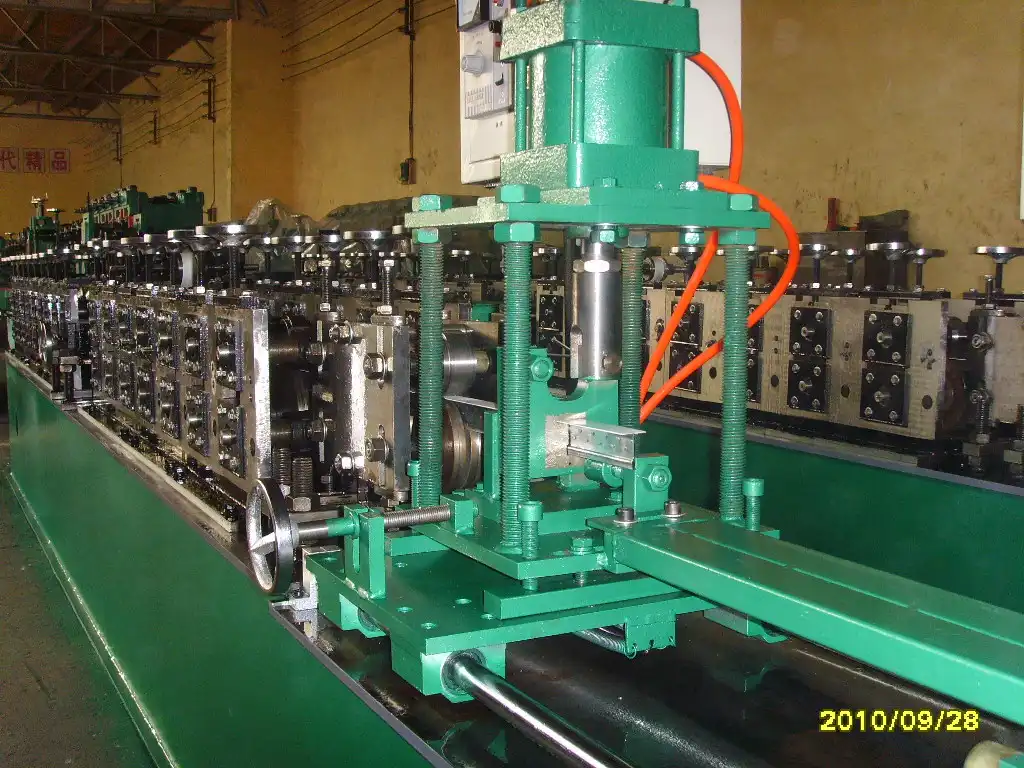
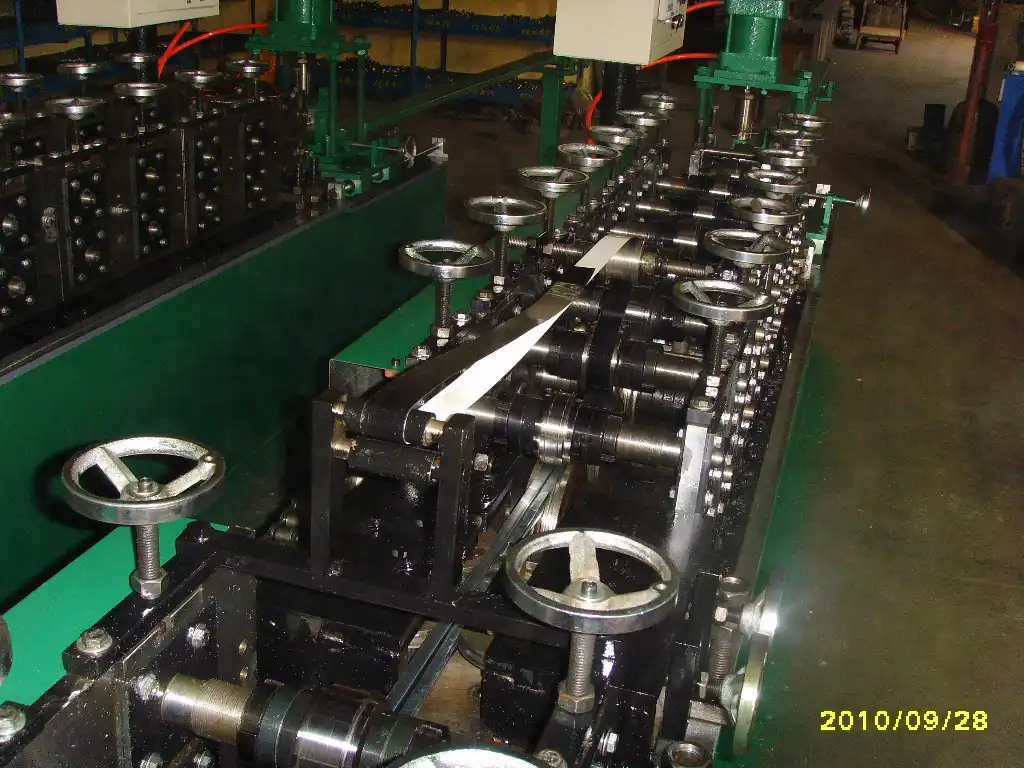
How good the profile is is directly related to how many passes are used to shape it. Main tee shapes need 18 roller stations to get the right T-shape, flange width, and hemmed edge. A cross-tee form has 16 points. Thin-gauge steel needs to be bent more times, slowly and carefully, so it stays straight.
Speed as a Design Parameter
The ceiling t bar roll forming machine’s line can punch and cut straight and moves at a speed of 0–20 m/min. That working speed is not a limit; it's what the design is trying to reach. You won't be able to get as much done even when the forming head is going at full speed if your decoiler, cutter, or stacker can't keep up.
Core Line Components and Their Technical Roles
Every station in the line has to be able to handle the capacity of the forming unit. Check out these important parts and see what you should look for in each one.
Decoiler
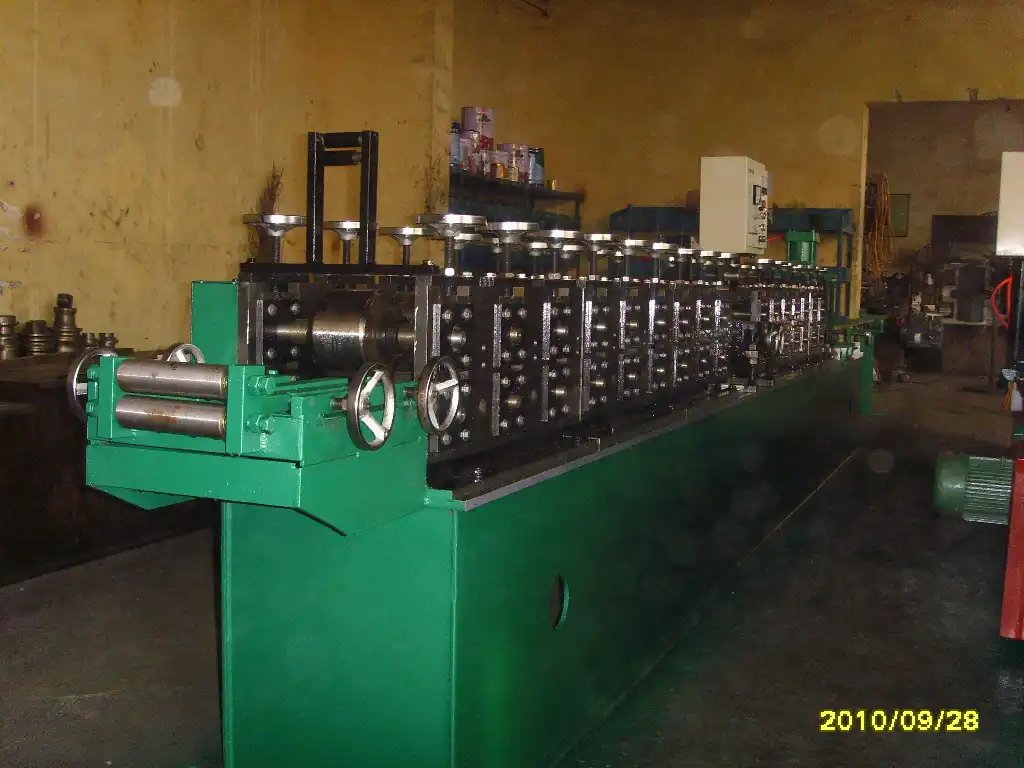
When the decoiler feeds coiled steel strip into the line, the tension stays the same. The decoiler must be able to handle coils with an inner diameter of 450–550 mm and a maximum load of 1.5 tons for this machine. The rolling shaft has a diameter of 50 mm and is made of 45# steel. This gives it the rigidity needed for consistent strip tension at 0.12 mm gauge material. A hydraulic expansion mandrel is standard; when running a lot of parts, manually loading wastes time during changeovers.
Roll Forming Unit
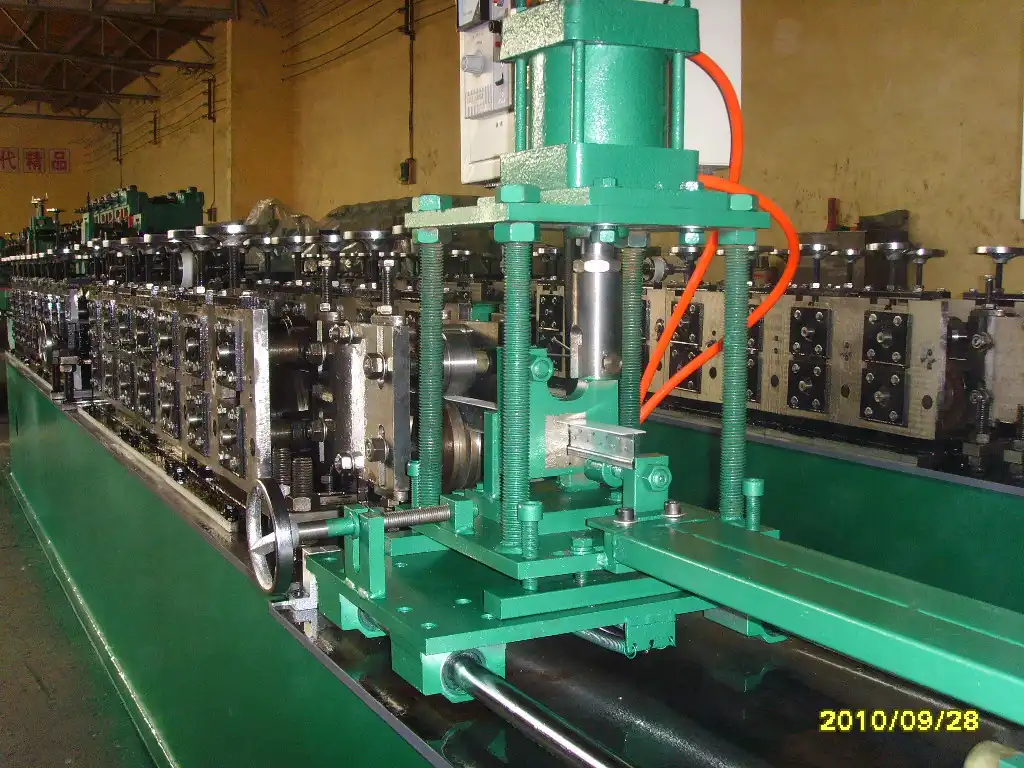
The heart of the line is the making unit. Rollers are made from GB-Cr12 tool steel, which is cut with a CNC machine and then hard chrome-plated. This grade doesn't wear down easily under high contact pressure and keeps PPGI-coated materials from getting surface marks. There are separate tool sets for the 18-station main tee configuration and the 16-station cross tee configuration. Manufacturers who run both main and cross tee profiles on the same line can benefit from quick-change cassette systems because they let them switch profiles without having to completely tear down the line.
Punching and Cut-Off System
The cutting module makes slots in the web at set distances, usually every 150 mm or 6 inches, so cross-tee links can fit. Alignment has to be exact; slots that aren't lined up right lead to fitting problems on the job site. Flying hydraulic cutting is used by the cut-off system to trim profiles at full line speed without stopping the strip feed. This method keeps the cut-length tolerance for 3,600 mm main tee lengths within ±0.5 mm and stops the ends from warping.
The production core is made up of the decoiler, the making unit, and the punch-cut system. Their needs must be met from the start; they can't be put on later as an afterthought. If the strip tension or cut time is off, straightness problems or burrs will show up in the first hour of production.
How Matched Components Improve Production Output
Picking parts that work well together does more than just keep problems from happening; it also directly boosts throughput and product consistency.
Throughput and Defect Reduction
The ceiling t bar roll forming machine's line can keep going at its full capacity as long as the decoiler feeds the strip at a steady tension and the PLC syncs the punching speed with the forming speed. When compared to lines put together from unmatched third-party parts, synchronized lines have fewer rejected profiles per shift, according to operators at facilities that use them.
Energy and Cost Efficiency
Hydraulic feeds that stay at the same pressure use more power than servo-driven feed systems. Servo synchronization cuts down on scrap from over-forming at low gage thicknesses on a line that processes 0.12 mm PPGI. This has a direct effect on the margin per linear meter of output for U.S. manufacturers who are worried about energy costs and waste.
Real-World Reference
The lines that Cangzhou Zhongtuo runs in facilities run by Tata Group (India) and DS Group (Korea) show that matched-component setups cut down on unplanned downtime. By integrating IoT from Siemens into the control system, real-time tracking and AI-assisted maintenance alerts are made possible, which lowers the cost of repairs that need to be done after the fact.
Selecting Components: What B2B Buyers Should Evaluate
When buying a T-grid production line, there's more to it than just comparing prices. These are the most important factors.
Production Capacity Alignment
Change the decoiler loading ability, the forming speed, and the stacker flow as per the quantity of work you wish to complete. Almost everything can be done with a 20 m/min line and a 1.5-ton decoiler. If you want to grow, ensure sure the machine frame can take bigger decoilers without changing the structure.
Automation Level vs. Budget
Fully automatic lines with servo feed, auto stacking, and PLC length counting cut worker cost over time. Semi-automated lines are less expensive to set up, but they require more human assistance to cut off and stack. What is best for you depends on how many orders you have and how much it costs to hire personnel.
Supplier Capability
If you buy from a tool builder with a track record of creating tools, you are less likely to get profile shape errors from bad rollers. Look for ISO 9001 and CE marks. “When you are running a private label program, you need to ensure that the provider can give you OEM tooling that is unique to the shape and plans that are covered by an NDA.”
Maintenance and After-Sales Support
Keeping a T-grid line running well long-term depends on planned maintenance and access to technical support.
Routine Maintenance Practices
On the ceiling t bar roll forming machine, the punching die is subjected to significant cyclic stress. The suggested maintenance cycle is die examination every 100,000 strokes. Punches should be sharpened or replaced as required. Hydraulic oil temperature should be within the operational range; installations in hot climates may need cooling circuit changes. PPGI coating build-up on roller surfaces scratches following coils. Roller surfaces must be cleaned after each shift.
Spare Parts and Remote Support
Access to original spare parts like rollers, punching dies, and cutting blades has to be guaranteed before purchase. Cangzhou Zhongtuo has a replacement parts program and offers Siemens integrated cloud diagnostics for remote problem detection. This means that technicians may detect motor or sensor failures without waiting for an on-site visit, cutting downtime significantly.
Operator Training
Even the best equipment needs to be operated by trained personnel. Ask your provider for video tutorials, wiring diagrams, and manuals in English. Zhongtuo provides technical documentation and remote commissioning help to foreign customers as standard.
Conclusion
Choosing the proper components of a ceiling t bar roll forming machine is important for a constant quality output, efficient production, and long-term cost savings. The combination of decoiler, roll forming unit, punching system, cutting mechanism, stacker, and PLC controls helps producers to minimise material waste, reduce downtime, and maintain correct profile dimensions. B2B purchasers can assess manufacturing capacity, amount of automation, tooling quality and after-sales assistance to make educated investment decisions. ZTRFM provides a wide array of customised solutions, reliable technical support and integrated manufacturing capabilities to enterprises looking to increase efficiency and develop a more competitive ceiling grid production operation.
FAQ
Q1: What raw materials does this line process?
The line processes PPGI and GI steel strip. PPGI at 0.12–0.3 mm is used for the T bar top material; GI at 0.2–0.4 mm is used for the bottom cap material.
Q2: How many roller stations are needed for main and cross tee profiles?
Main tee profiles require 18 roller stations. Cross tee profiles use 16 stations. Each set has dedicated GB-Cr12 tooling.
Q3: What is the working speed with punching and cutting active?
The line operates at 0–20 m/min with inline punching and cutting engaged. Speed can be adjusted based on material gauge and profile complexity.
Q4: What is the decoiler's loading capacity and coil size range?
The decoiler carries up to 1.5 tons and accepts coils with inner diameters of 450–550 mm. The shaft is 45# steel with a 50 mm diameter.
Request a Quote from ZTRFM — Ceiling T Bar Roll Forming Machine Supplier
Since 2014, ZTRFM (Cangzhou Zhongtuo) has built and shipped T-grid production lines utilizing the ceiling t bar roll forming machine to more than 150 different countries. Our factory is ISO 9001, CE, and CAS certified, and we work with Siemens to monitor uptime using IoT. We also offer OEM tools, private-label programs, and full supply from decoiler to stacker. To get specs or a factory quote, email our engineering team at zhongtuorollforming@gmail.com.
References
1. Steel Framing Industry Association (SFIA). Technical Guide for Cold-Formed Steel Framing. 2022.
2. American Society for Testing and Materials. ASTM C635: Standard Specification for the Manufacture, Performance, and Testing of Metal Suspension Systems for Acoustical Tile and Lay-In Panel Ceilings. 2020.
3. Bhattacharyya, D. Cold Roll Forming of Thin-Gauge Steel Sections. Journal of Materials Processing Technology. 2018.
4. Zhang, W., & Li, H. Precision Control in Roll Forming of Light-Gauge Galvanized Steel Profiles. International Journal of Advanced Manufacturing Technology. 2021.
5. Metal Construction News. Suspended Ceiling Systems: Materials, Manufacturing, and Market Trends. 2023.
6. Halmos, G.T. Roll Forming Handbook. CRC Press. 2006.