- English
- French
- German
- Portuguese
- Spanish
- Russian
- Japanese
- Korean
- Arabic
- Irish
- Greek
- Turkish
- Italian
- Danish
- Romanian
- Indonesian
- Czech
- Afrikaans
- Swedish
- Polish
- Basque
- Catalan
- Esperanto
- Hindi
- Lao
- Albanian
- Amharic
- Armenian
- Azerbaijani
- Belarusian
- Bengali
- Bosnian
- Bulgarian
- Cebuano
- Chichewa
- Corsican
- Croatian
- Dutch
- Estonian
- Filipino
- Finnish
- Frisian
- Galician
- Georgian
- Gujarati
- Haitian
- Hausa
- Hawaiian
- Hebrew
- Hmong
- Hungarian
- Icelandic
- Igbo
- Javanese
- Kannada
- Kazakh
- Khmer
- Kurdish
- Kyrgyz
- Latin
- Latvian
- Lithuanian
- Luxembou..
- Macedonian
- Malagasy
- Malay
- Malayalam
- Maltese
- Maori
- Marathi
- Mongolian
- Burmese
- Nepali
- Norwegian
- Pashto
- Persian
- Punjabi
- Serbian
- Sesotho
- Sinhala
- Slovak
- Slovenian
- Somali
- Samoan
- Scots Gaelic
- Shona
- Sindhi
- Sundanese
- Swahili
- Tajik
- Tamil
- Telugu
- Thai
- Ukrainian
- Urdu
- Uzbek
- Vietnamese
- Welsh
- Xhosa
- Yiddish
- Yoruba
- Zulu
How to adjust roll forming machine tracking deviation?
If your production line is producing warped panels, uneven edges, or inconsistent rib profiles, tracking deviation is likely the cause. Adjusting tracking deviation on a roof & wall panel roll forming machine requires a systematic approach: inspect roller alignment, check guide rail positioning, verify raw material consistency, and recalibrate feeding tension. Correcting these issues in the right sequence restores forming precision and protects panel quality. This guide walks you through every step—from diagnosis to prevention—so your production line stays accurate and efficient.
Understanding Roll Forming Machine Tracking Deviation
Tracking deviation is one of the most annoying things about making metal panels. It makes the coil strip move from side to side as it goes through the sites where it is made, which wastes material and slows down the process.
What Causes Tracking Deviation?
Usually, it's because of differences in materials (like coil strips that aren't all the same width or thickness) or mistakes in the way they were set up (like guide rails that aren't lined up right or rollers that aren't parallel to each other). Over time, the drift is caused by wear on the bearings and play in the shaft.
How Environment Affects Tracking
Vibrations on the factory floor, changes in temperature, and uneven machine bases are all things that can move roller positions a little. If the side changes by just 0.5 mm, it can mess up the shape on high-speed lines that make triangular or PBR-style wall panels in a matter of minutes.
Why It Matters for Panel Quality
The rib heights change, the edge trims move out of place, and the seams that meet no longer line up when the tracking on a metal roofing sheet machine changes. This directly impacts how well exposed-fastener panels like R-Panel or PBU panels fit together and keep the weather out in a PEB building.
Diagnosing Tracking Deviation Issues – Systematic Approach
Before making any adjustments, you need to confirm exactly where the deviation originates. Guessing wastes time and may introduce new misalignment.
Visual and Mechanical Inspection
Start by running the line slowly and watching the strip path at each roller station. Mark the point where lateral drift first appears. Then shut down the roof & wall panel roll forming machineand physically check roller shafts for play, inspect guide rails for wear grooves, and look for any loose fasteners on the forming bed frame.
Evaluating Raw Material Uniformity
Material preparation strongly shapes tracking behavior. Measure coil width at multiple points using a caliper. Width variation greater than ±0.5 mm can consistently push the strip to one side. Check the decoiler brake tension—loose tension allows the coil to feed unevenly, amplifying any downstream misalignment.
Using Precision Measurement Tools
A dial indicator mounted on a fixed reference point lets you measure lateral runout at each roller shaft. For complete forming lines—especially those producing standing seam or flush wall cladding panels—a laser alignment tool gives you a straight reference line across all stations simultaneously, revealing which rollers are out of plane.
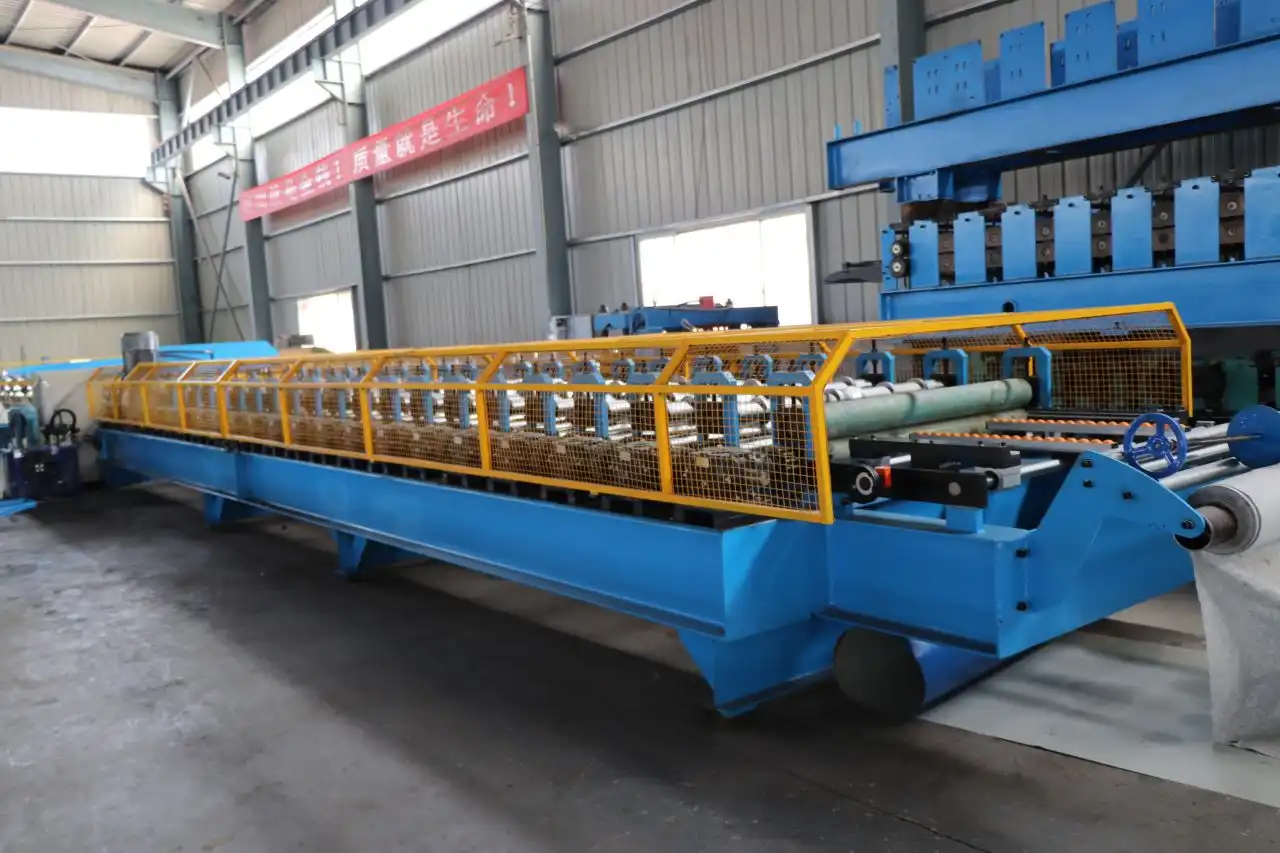
Step-by-Step Guide to Adjusting Roll Forming Machine Tracking Deviation
Follow this step-by-step plan once you know where the problem is coming from. You might make things worse when you make changes quickly without a standard.
Step 1 – Safety Protocols and Baseline Reset
Lock out and tag out the machine before touching any moving parts. Write down the roller setting at this point, using the numbers on the gear indicator. This is the baseline to evaluate whether a modification makes tracking worse.
Step 2 – Roller and Guide Rail Realignment
Start with the first set of rails. When set up, the strip has to be in the center of the first forming station. Next, modify the position of the rollers on the side by moving the side-adjustment bolts, one workstation at a time. Ensure each roller is straight across from its shaft using an accurate measuring instrument. The aim is for the pressure to be the same all around the strip. The strain isn't even, and that's one of the big reasons why lengthy panel runs bend and twist.
Step 3 – Fine-Tuning the Feeding Mechanism
Move the feeder guide fingers so the strip enters the first pass in the center and is not loaded on the sides. Adjust the decoiler brake setting to maintain a consistent, mild back pressure. For the pre-coated PPGI or aluminum coils typically used in creating wall cladding, while you are designing lines, you should slow down the feeding speed a little at the beginning so that the guides will not scrape the surface when moving. Then, after each adjustment, do a brief test batch and look at your profile photo and check how the completed panel's edge-to-edge width and rib height compare. Do this again and again until the full length of the panel is up to requirements.
Maintenance Tips to Prevent Tracking Deviation
To fix a mistake, you have to act. Over the life of the machine, it saves a lot more time and money to keep it in good shape.
Scheduled Inspections and Lubrication
The tension on the chain drive, roller bearings, and any worn areas on the guide rails are checked weekly to ensure the roof & wall panel roll forming machineis in excellent condition. Lubricate the bearing housings as per manufacturer’s specifications. The strip route is less stable as the shaft travels with dry bearings and the bearings lose their play more rapidly. It’s cheaper to fix worn guide plates before they acquire grooves in them than to halt production.
Operator Training and Shift Checklists
They need to learn about them so they may recognize early symptoms of tracking behavior, such as a curling strip edge, a little change in rib height, or funny sounds at a manufacturing station. It may save hours of labor to rectify issues and prepare a fast list of items to check before each shift, such as the entrance guide and the tightness of the decoiler.
IoT Sensors and Real-Time Monitoring
More and more advanced roll-forming lines are using moving sensors at critical forming spots to constantly monitor the lateral strip. If the strip passes a specific point, then the gadget either signals to the operator or changes the guide to a new location. This technique is currently included in panel forming machines in the midrange price range. It ensures uniformity of commercial cladding and large-scale PEB ventures.
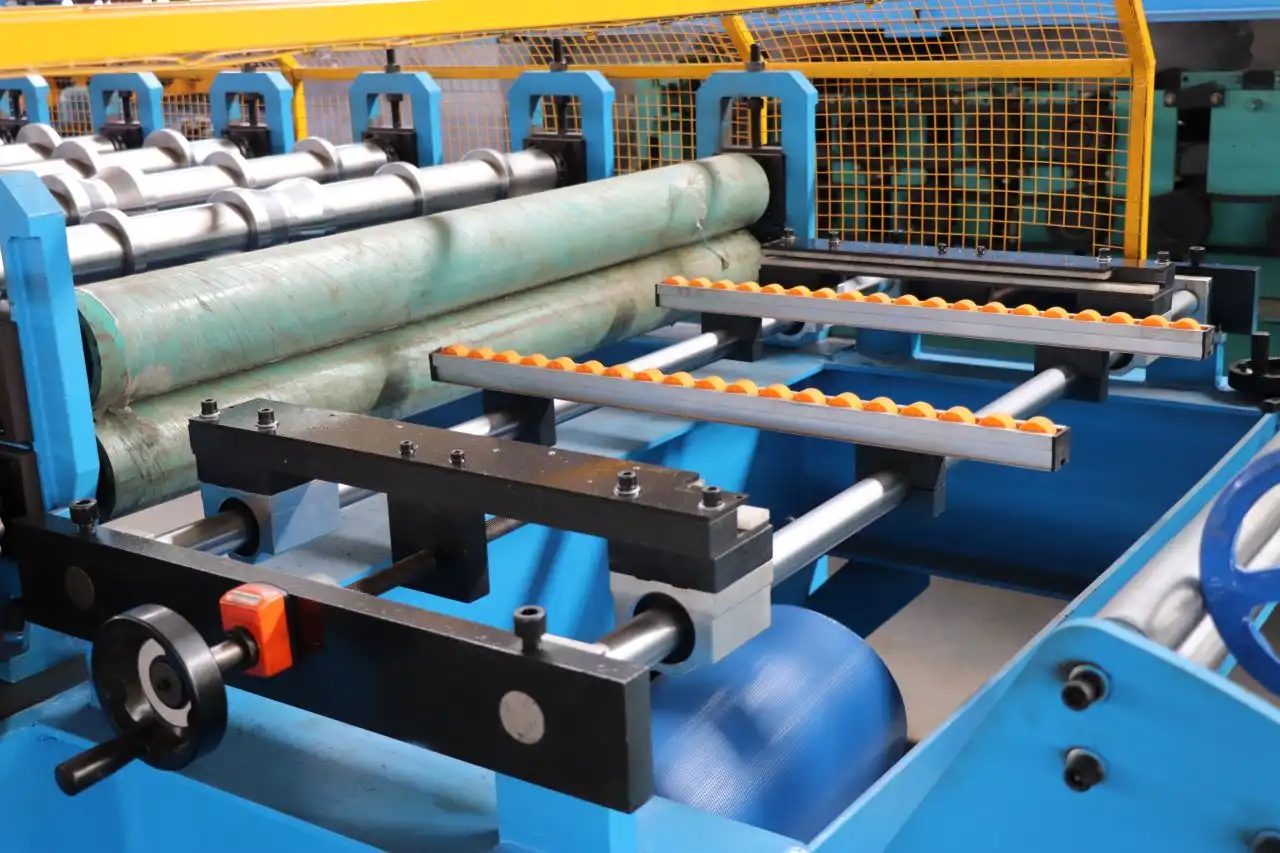
Choosing the Best Roof & Wall Panel Roll Forming Machines to Minimize Tracking Issues
The best way to monitor variation over the long haul is to build a precise machine from the beginning. The frequency of issues with alignment directly depends on the quality of your equipment.
Automatic vs. Semi-Automatic Models
Fully automated lines with servo-driven feeding and closed-loop position control provide far more reliable strip centering than manual or semi-automatic systems. For producers that produce numerous profiles (R-Panel, PBR, Valley Rib, or bespoke wall cladding sections), automated changeover systems also save realignment time between profile runs.
Evaluating Roller Quality and Control Systems
Look for machines with rollers made from 45# steel with a chrome-plated finish. Chrome plating increases roller life, protects surface finish on pre-coated materials, and maintains dimensional tolerance for longer periods between maintenance. The structure of the forming bed should be formed of heavy H-steel; 350 H-steel construction resists flexing due to vibration that slowly alters roller alignment. A PLC control system with length-measurement and automated cutting integration, which decreases position errors that contribute to tracking drift, achieves complete line synchronization.
After-Sales Support and Warranty Value
A machine supplier offering commissioning assistance, operator training, and ready availability of replacement parts cuts the true cost of ownership substantially. After-sales response is as vital as the machine’s original specification sheet for procurement teams developing new panel factories or growing their capacity in the U.S. market.
Conclusion
Roof & wall panel roll formingmachine linee tracking deviation correction is a rigorous process. You have to determine the reason, adjust one thing at a time, verify the results with test production, and keep the machine in excellent condition at all times. And they’re less likely to occur in the first place with the correct instruments. To produce the same-looking panels every time, you need equipment with robust rollers, solid frames, and dependable PLC control. Whenever you use R-Panel, PBU, standing seam, or bespoke wall covering profiles, you need to make sure they are properly aligned and maintain them aligned with routine maintenance.
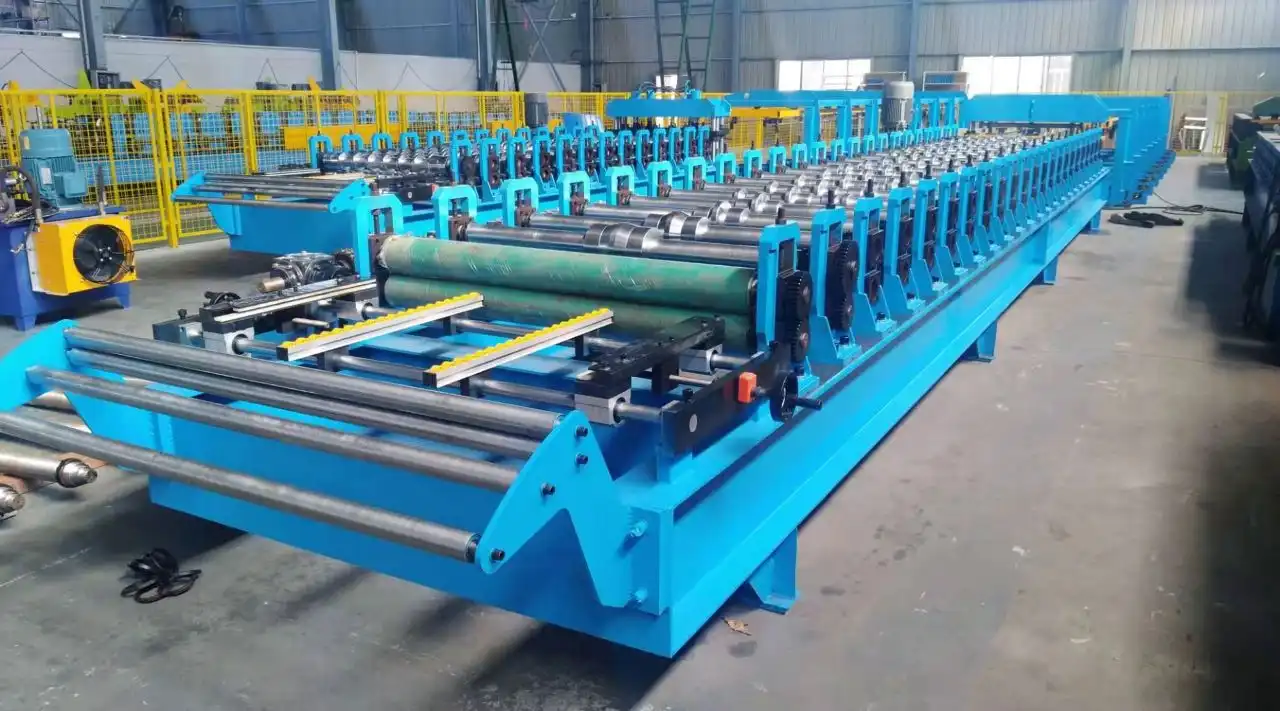
FAQ
1. What are the most common causes of tracking deviation in a roll forming line?
Most tracking issues are caused by wheels or guide rails that aren't lined up right (especially ones that aren't straight) and materials that aren't consistent (like coils that are different widths or thicknesses). It can also be caused by making bed pins that are loose or worn out.
2. How often should I inspect the machine to prevent tracking deviation?
Once a week, visual checks and greasing of the bearing housings are a good place to start in most commercial setups. A lot of people use lines that run two or three shifts a day. Every three to five days, check the wear on the guide rails.
3. Can automation fully eliminate the need for manual tracking adjustment?
A lot less work needs to be done by hand on modern machines that are run by PLCs and have real-time displacement sensors. Still, there needs to be an operator to watch over things. Drift can be detected by sensors, but the wear on the rollers and guides still needs to be checked and fixed as needed.
4. Does coil material type affect tracking behavior?
Yes. Metal coils are softer and more likely to bend along the edges when the guide pressure is too high. Care must be taken when handling pre-coated PPGI so that the surface does not get scratched. The guide contact pressure needs to be changed depending on the type of material. This is part of setting up the machine correctly.
Talk to ZTRFM About Your Roll Forming Equipment Needs
People from more than 150 countries have bought cold roof & wall panel roll forming machines made by ZTRFM since 2014. We sell tools that are made to meet ISO9001 and CE standards for making roof and wall panel rolls. They have 350 H-steel frames, 45# chrome-plated rollers, and PLC control systems that let them go up to 60 m/min. To set up a meeting, please email us at zhongtuorollforming@gmail.com if you want to build a new panel plant, boost output, or get rid of old equipment.
References
1. Almos, George T. Roll Forming Handbook. CRC Press, 2006.
2. American Iron and Steel Institute. Cold-Formed Steel Design Manual. AISI, 2016.
3. Bhattacharyya, Debes. Composite Sheet Forming. Elsevier Science, 1997.
4. Lange, Kurt. Handbook of Metal Forming. Society of Manufacturing Engineers, 1985.
5. Metal Construction Association. Metal Roof and Wall Systems Manual. MCA, 2020.
6. Schuler GmbH. Metal Forming Handbook. Springer, 1998.