- English
- French
- German
- Portuguese
- Spanish
- Russian
- Japanese
- Korean
- Arabic
- Irish
- Greek
- Turkish
- Italian
- Danish
- Romanian
- Indonesian
- Czech
- Afrikaans
- Swedish
- Polish
- Basque
- Catalan
- Esperanto
- Hindi
- Lao
- Albanian
- Amharic
- Armenian
- Azerbaijani
- Belarusian
- Bengali
- Bosnian
- Bulgarian
- Cebuano
- Chichewa
- Corsican
- Croatian
- Dutch
- Estonian
- Filipino
- Finnish
- Frisian
- Galician
- Georgian
- Gujarati
- Haitian
- Hausa
- Hawaiian
- Hebrew
- Hmong
- Hungarian
- Icelandic
- Igbo
- Javanese
- Kannada
- Kazakh
- Khmer
- Kurdish
- Kyrgyz
- Latin
- Latvian
- Lithuanian
- Luxembou..
- Macedonian
- Malagasy
- Malay
- Malayalam
- Maltese
- Maori
- Marathi
- Mongolian
- Burmese
- Nepali
- Norwegian
- Pashto
- Persian
- Punjabi
- Serbian
- Sesotho
- Sinhala
- Slovak
- Slovenian
- Somali
- Samoan
- Scots Gaelic
- Shona
- Sindhi
- Sundanese
- Swahili
- Tajik
- Tamil
- Telugu
- Thai
- Ukrainian
- Urdu
- Uzbek
- Vietnamese
- Welsh
- Xhosa
- Yiddish
- Yoruba
- Zulu
How many roll forming lines for an EPC project?
One to two lines of C purlins are needed for most EPC projects. The exact number is not based on the size of the building but on the tonnage, profile variety, and schedule. While multi-building or multi-site programs frequently require two or more lines, a single c purlin making machine operating at 8–15 m/min can serve a single warehouse. I suggest dividing the number of meters needed by the monthly output of one line and then adding a schedule buffer. I'll show you how to do that calculation, how our ZTRFM machine is set up, and how to compare your options before you ask for a quote below.
What Determines the Number of Roll Forming Lines? Product Scope Matters More Than Building Size
Even if two projects are on the same floor, they may need very different tools. A warehouse that only has wall girts and C purlins needs one profile family. A plant that needs Z purlins, decking, and wall panels also needs a lot of them. For each group of products, there are different needs for tools, strip width, and cutting. It has the web width, flange height, lip size, steel thickness, and hole pattern. This is what I start with: the profile list from the approved drawings. For structural sections, the choice of machine is based on the thickness. Our line can handle material from 1 mm to 3.5 mm thick, which includes a lot of roof purlins, wall girts, and mezzanine joists. The lines for panels and decking should be kept separate.
A Practical Formula for Estimating Lines
To find the effective monthly output, multiply the speed by 60 and the number of running hours by the efficiency. If a line moves at 10 m/min and works 160 hours a month at 65% efficiency, it makes 10 × 60 × 160 × 0.65 = 62,400 m. To find the right answer, divide 120,000 m by 62,400, which gives you 1.92. This means that two lines are the best choice. Changes in coils, punching, setup, maintenance, and inspection are all taken into account by the efficiency factor. The number 65% is just an example. It should be replaced with records from your factory or a profile test from a supplier.
When One Line Is Enough and When You Need Two
Month-to-month demand is well below effective output, profile changes are rare, and the delivery window is flexible. One line is enough. In this case, small business buildings and single warehouses usually work. When C and Z purlins need to run at the same time, when contract deadlines are set, or when one breakdown would stop the whole site, it makes sense to use two or more lines. You are also covered by a second line while the blades are being changed and fixed. I think you should keep at least one reserve shift open every week in case some coils arrive late and throw off the schedule.
Match Roll Forming Lines to EPC Project Scenarios
Small Commercial or Single-Warehouse Projects
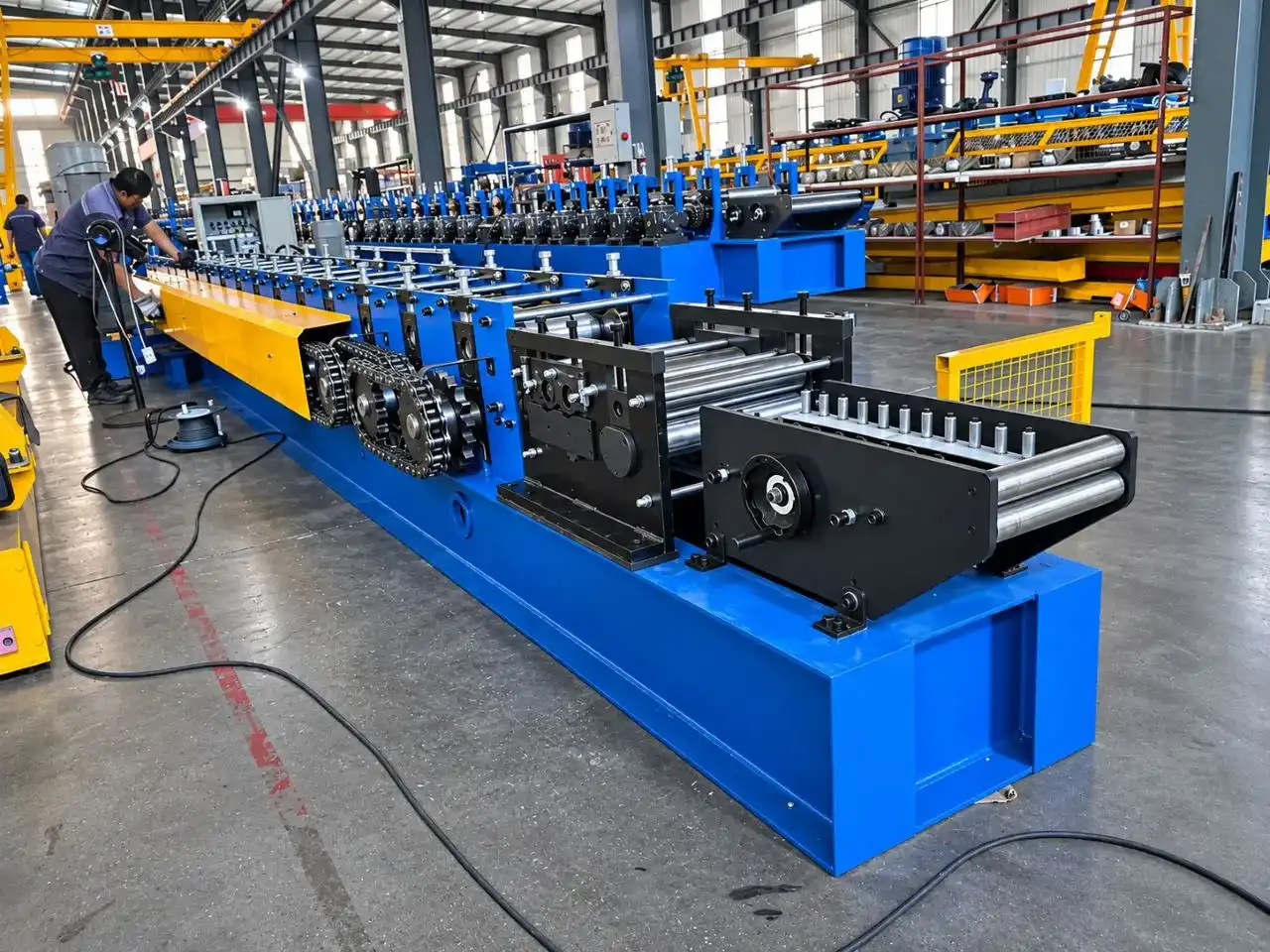
One adjustable line usually does the job for a single warehouse. A mezzanine frame, roof purlins, and wall girts all use the same section sizes a lot of the time, so all of them can be made on the sameC purlin making machine with stands that can be moved around. Twelve to sixteen forming stations are paired with inline punching and hydraulic cutting on the ZTRFM line. This means that bolt holes and cut lengths come off the same line. So, there is no need for a separate drilling step, and the hole spacing is the same from piece to piece. A small order doesn't usually take a whole month to make, so spend your money on a rigid frame and good tools instead of speed that the project doesn't need.
Multi-Building Warehouse Projects
Volume goes up, and delivery milestones are added by adding more buildings on the same campus. Then you pick between one high-speed line and two regular lines. One faster line saves ground space and work, but one asset is needed for the whole project to work. Two standard lines are connected to each other so that the output stays the same during maintenance. One line can make C sections while the other runs Z sections. If you don't have a lot of floor space, our CZ combined quick-change head lets a single machine go from C to Z in the same shift. This is useful for mixed orders. Before you decide, you should weigh the risk to the schedule against the extra worker and floor space.
Large Industrial and Multi-Country Programs
For big projects, it makes sense to have separate lines for each profile family, like one for C purlins, one for Z purlins, and separate equipment for panels. When factories are spread out across several countries, freight costs may be lower. Before you place the order, make plans for the voltage in your area, the installation, and spare parts. We offer the whole steel purlin production line, including the decoiler, the former, the stacker, and any spare parts. This way, the package can be coordinated by just one supplier. Our machines are used in more than 150 countries, which helps our engineers learn how to work with different types of electricity and sites.
How a C Purlin Making Machine Works
How the C Purlin Production Process Runs
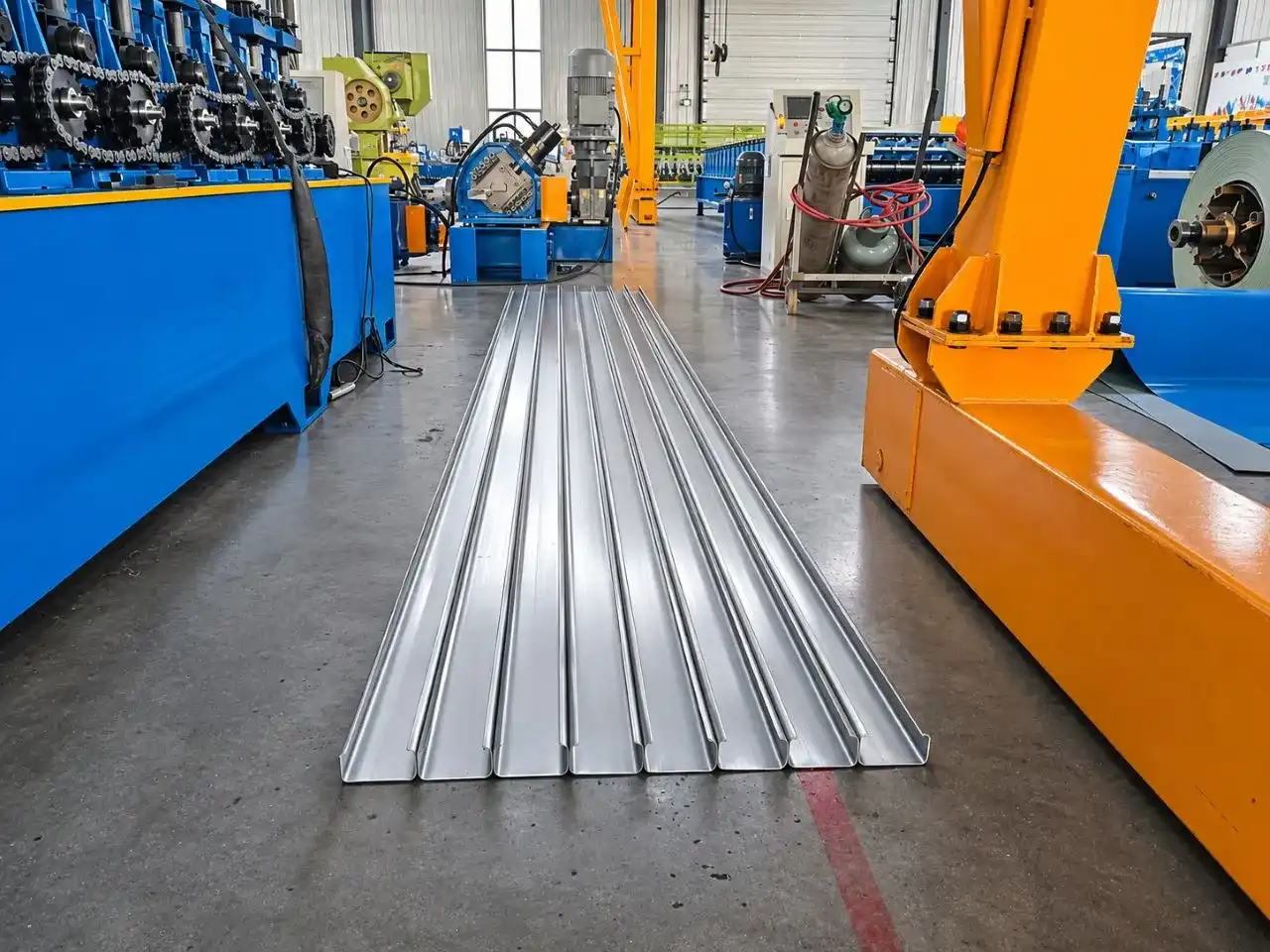
The first step is to load the coil onto a decoiler. The next steps are leveling, feeding, inline punching, progressive roll forming, hydraulic cutting, and discharge. Punching is done on a flat strip before it is formed, so the holes stay in the right place. After that, the strip goes through 12 to 16 forming stations. At each station, a new set of rollers bends the web, flanges, and lips just a bit more. The zinc coating on galvanized steel and the accuracy of its measurements are both protected by gradual bending. The section is put on the run-out table after a final cut at the set length. Before the full run starts, compare the first piece to your drawing.
Our Standard Machine Configuration
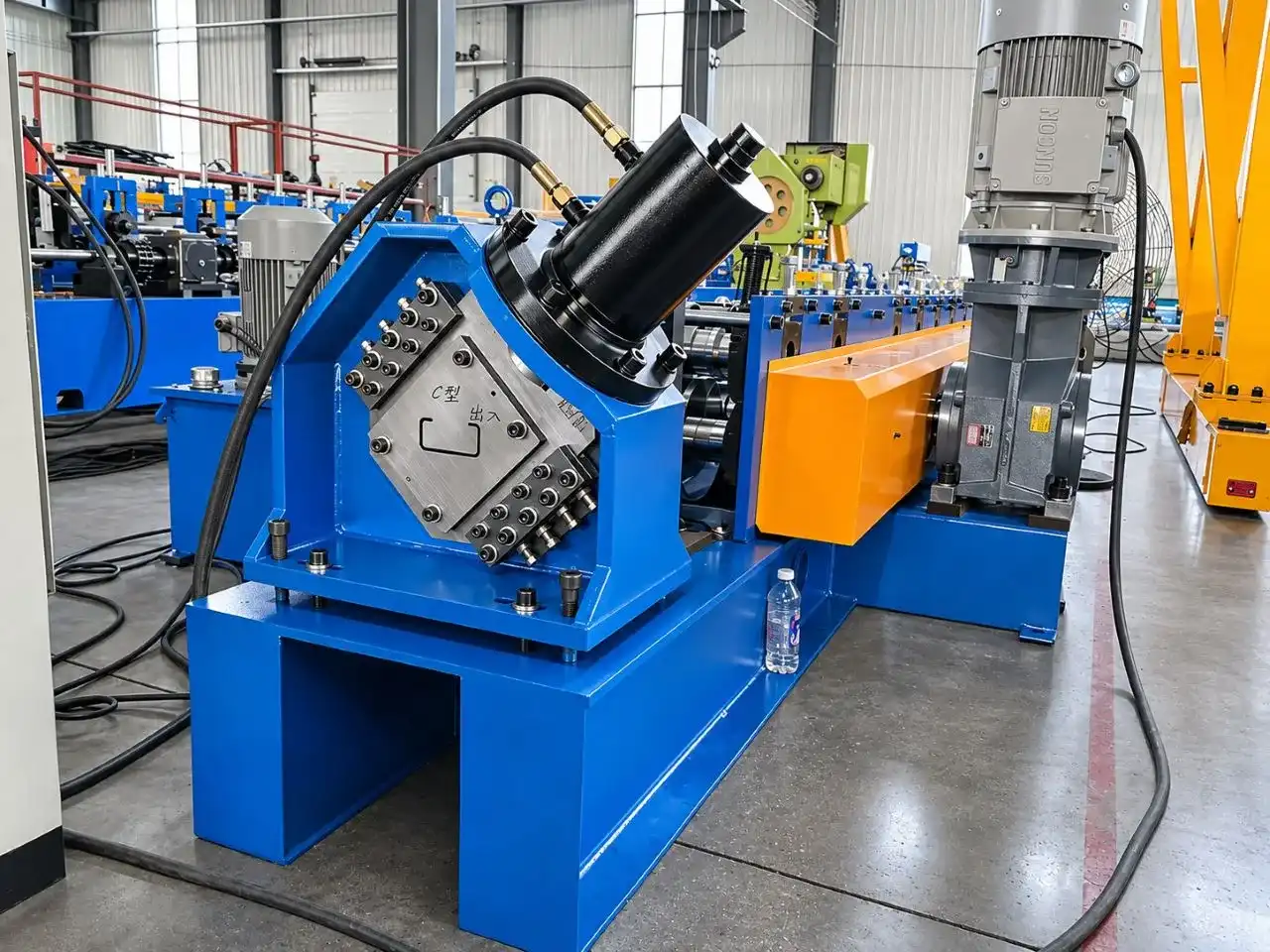
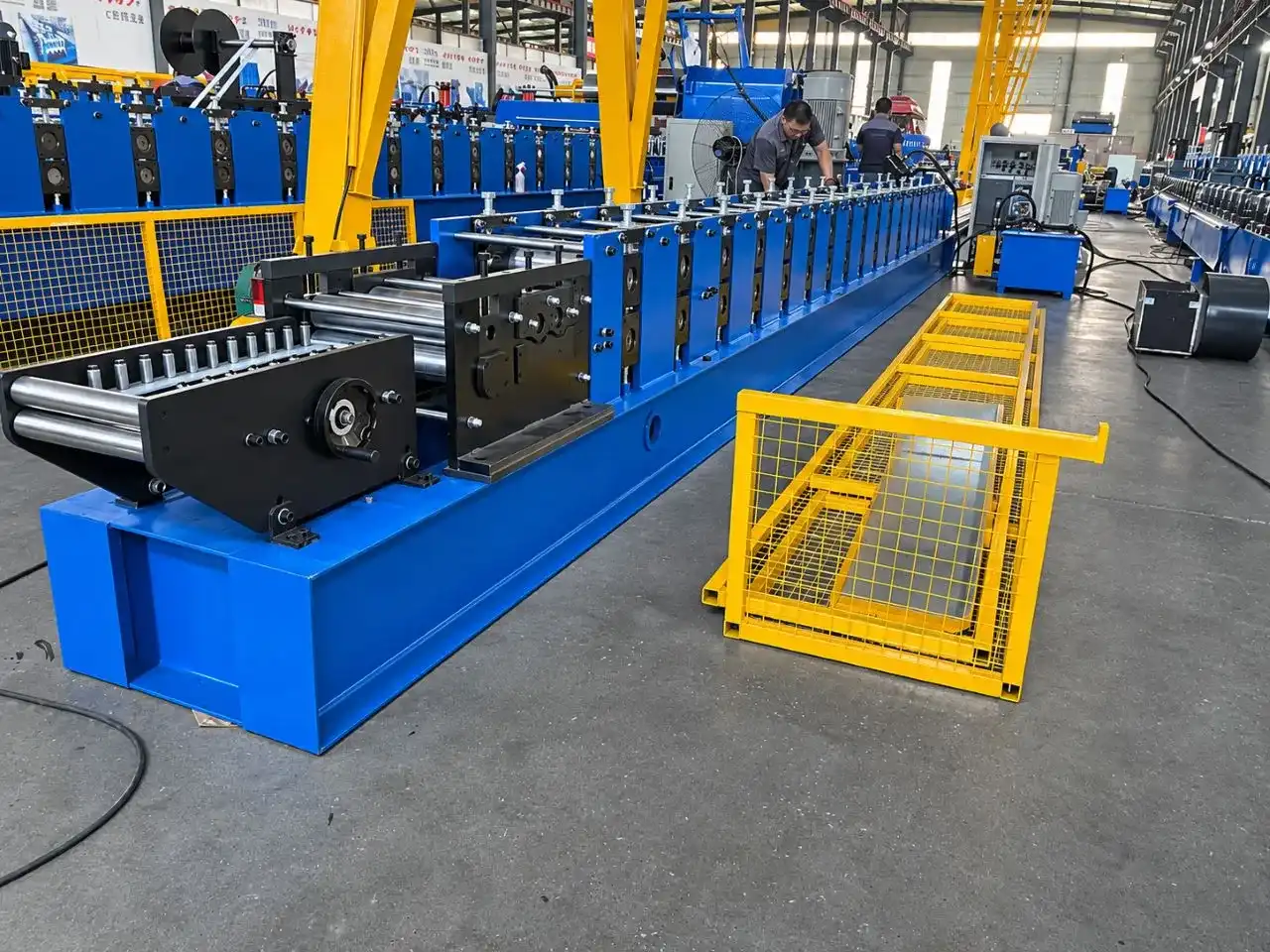
In simple terms, this is how I describe our standard C purlin roll forming machine. At 8–15 m/min, it makes stuff that is 1–3.5 mm thick. Formed shafts are made of 45# steel, and an 11–15 kW main motor drives them through a chain transmission. It's easy to check and fix the chain transmission. The frame is made of 400 H steel, which doesn't shake when you run thicker gauges. Power comes standard at 380V, 50Hz, three-phase, but we can set up other voltages if you ask. That's important because most plants in the US use a 60 Hz supply. You can choose to use servo punching or the CZ quick-change head.
Cutting and Key Components
A 5.5–7.5 kW power unit is used for hydraulic cutting on the line. The blades are made of Cr12 steel that has been cooled to between 60 and 62 HRC. That's why we use hydraulic cutting on this line: it gives steady force to thin structural steel. If the gap between the blades doesn't match the thickness of the sheet, burrs will form, and the blades will not last long. Aside from the cutter, the section quality is also affected by the decoiler's capacity, the feeder, the guides, and the roller finish. Ask for records of roller hardness and a load test with material that is the thickest that can be used when you compare quotes. These tests show what happens when the c purlin making machine is actually used.
Capacity and Line Type: Choosing Before You Buy
Why Advertised Speed Is Not Actual Output
A speed rating of 15 m/min only talks about forming. Punching, short cut lengths, acceleration, coil changes, and stacking by hand all lower the output that can be used. It takes longer to start and stop a 3 m piece with lots of holes than a plain 12 m section. Running must also be slower when the steel is thicker. So, you should get a quote for the purlin machine's production capacity based on your specific profile, thickness, and hole pattern. I ask buyers for approved drawings so that our engineers can estimate how much work will actually get done instead of giving a brochure number. That's how you should compare quotes, not just the fastest speed.
Dedicated C Line Versus CZ Interchangeable Machine
A dedicated C line is easier to use and works for people who only make C sections. It's more expensive, but a CZ interchangeable machine can handle both profiles. This is useful when designs change or when you sell cut-to-length pieces to different customers. If you often work with Z purlins, one CZ line can do the job of two separate machines. If you want to buy an automatic purlin machine, find out how it handles changes in size and how much more it costs. Decide which machine will work best for your order mix. The most powerful machine isn't always the best one to use.
Checklist Before Requesting a Quotation
Send the following for a project-specific answer: profile drawings, steel grade and thickness, coil width and weight, hole patterns, cut lengths, monthly tonnage, delivery milestones, power supply, and workshop space. The grade of steel is also important. ASTM A653 is often used for galvanized sheet in the US, and AISI S100 is used for cold-formed member design. The standards that apply to your project should be checked by your engineer. Full data also speeds up the process of revising quotes. It helps us make sure that each piece fits the machine and figure out a reasonable line count for your schedule.
Conclusion
A project's number of roll forming lines is based on the type of product, the amount of work to be done, the number of different profiles, and the schedule, not on the size of the building. The formula for effective output shows why rated speed isn't always accurate. Real output goes down because of setup, coil changes, and punching, so the number of meters needed should be divided by the actual monthly production. One line that can be adjusted works for small projects. For mixed or large orders, two parallel lines or a c purlin making machine work best. For large multi-site programs, dedicated lines work best. This page talks about a machine that can shape 1–3.5 mm steel at 8–15 m/min. It has 12–16 stations, a 400 H steel frame, and hydraulic cutting. The schedule is kept safe by a capacity buffer and approved drawings.
FAQ
1. How many C purlin making machines does a typical EPC project need?
A lot of projects need one or two. Add a schedule buffer and divide the number of meters needed by the monthly output of one line.
2. Can one machine produce both C and Z purlins?
Yes, a CZ machine that can be switched out can. Our CZ had quick-change head switches that let us go from C to Z in one shift.
3. Can the machine process galvanized steel?
Our line can shape steel that is 1 to 3.5 mm thick and can also work with galvanized coil. Send us information about your grade and coating so that our engineers can check them against your drawing.
Request a C Purlin Making Machine Quote from ZTRFM
Since 2014, ZTRFM has been building cold roll forming machines in Botou, Cangzhou. The company is certified by ISO 9001, CE, and CAS, and it sends its products to more than 150 countries. Look for a company that can supply you with a c purlin making machine for your EPC project. Send your profile drawings, the thickness of the steel, and your monthly goal to zhongtuorollforming@gmail.com. Our engineers will then suggest a line count and configuration.