- English
- French
- German
- Portuguese
- Spanish
- Russian
- Japanese
- Korean
- Arabic
- Irish
- Greek
- Turkish
- Italian
- Danish
- Romanian
- Indonesian
- Czech
- Afrikaans
- Swedish
- Polish
- Basque
- Catalan
- Esperanto
- Hindi
- Lao
- Albanian
- Amharic
- Armenian
- Azerbaijani
- Belarusian
- Bengali
- Bosnian
- Bulgarian
- Cebuano
- Chichewa
- Corsican
- Croatian
- Dutch
- Estonian
- Filipino
- Finnish
- Frisian
- Galician
- Georgian
- Gujarati
- Haitian
- Hausa
- Hawaiian
- Hebrew
- Hmong
- Hungarian
- Icelandic
- Igbo
- Javanese
- Kannada
- Kazakh
- Khmer
- Kurdish
- Kyrgyz
- Latin
- Latvian
- Lithuanian
- Luxembou..
- Macedonian
- Malagasy
- Malay
- Malayalam
- Maltese
- Maori
- Marathi
- Mongolian
- Burmese
- Nepali
- Norwegian
- Pashto
- Persian
- Punjabi
- Serbian
- Sesotho
- Sinhala
- Slovak
- Slovenian
- Somali
- Samoan
- Scots Gaelic
- Shona
- Sindhi
- Sundanese
- Swahili
- Tajik
- Tamil
- Telugu
- Thai
- Ukrainian
- Urdu
- Uzbek
- Vietnamese
- Welsh
- Xhosa
- Yiddish
- Yoruba
- Zulu
Roll forming vs. Press brake: Which is right for my profile?
If you need to create lengthy, repetitive trapezoidal wall or roof panels from coil, then a trapezoidal sheet roll forming machine is typically the best solution. “It profiles in one go, so the output is the same and the panel dimensions are the same from shift to shift.” A press brake is excellent for prototypes, flashings, short pieces, and designs that regularly change. This guide was created from the point of view of the factory at ZTRFM to assist you in finding the correct approach for your volume, profile, material, and budget.
Why the Choice Matters for Trapezoidal Profiles Two Different Ways to Shape Metal
One line at a time, a press brake bends a sheet. The operator puts the blank in place, the punch comes down, and the part moves to the next bend. A roll former does something different. The coil goes through a set of roller stations. Each station adds a small part of the last bend until the full trapezoid shape is seen. This kind of shaping is more gradual, so each pass puts less stress on the coating. Most of the comparisons below are based on this one difference: press braking likes flexibility, while roll forming likes steady, repeatable output.

How a Trapezoidal Sheet Roll Forming Machine Works
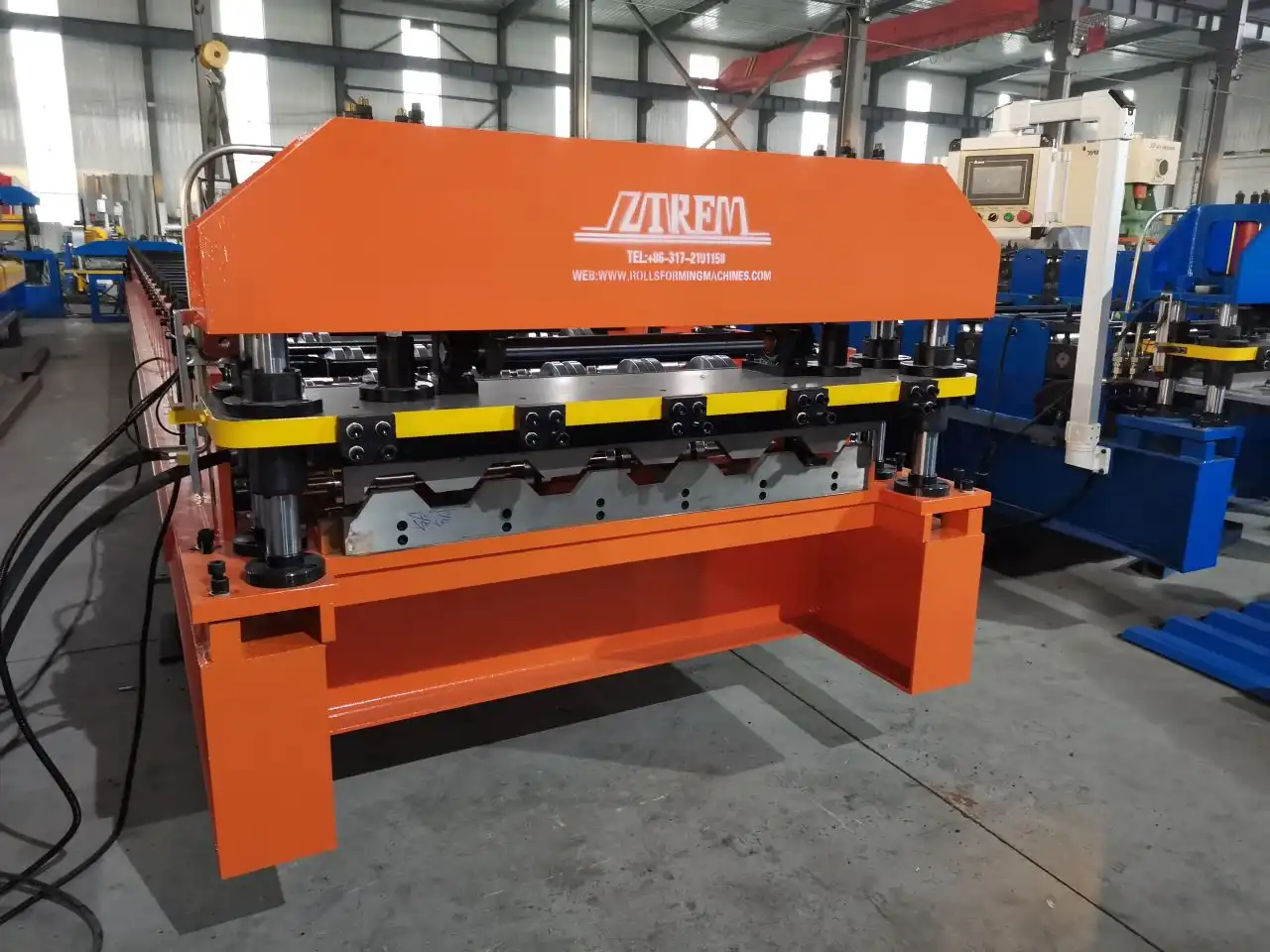
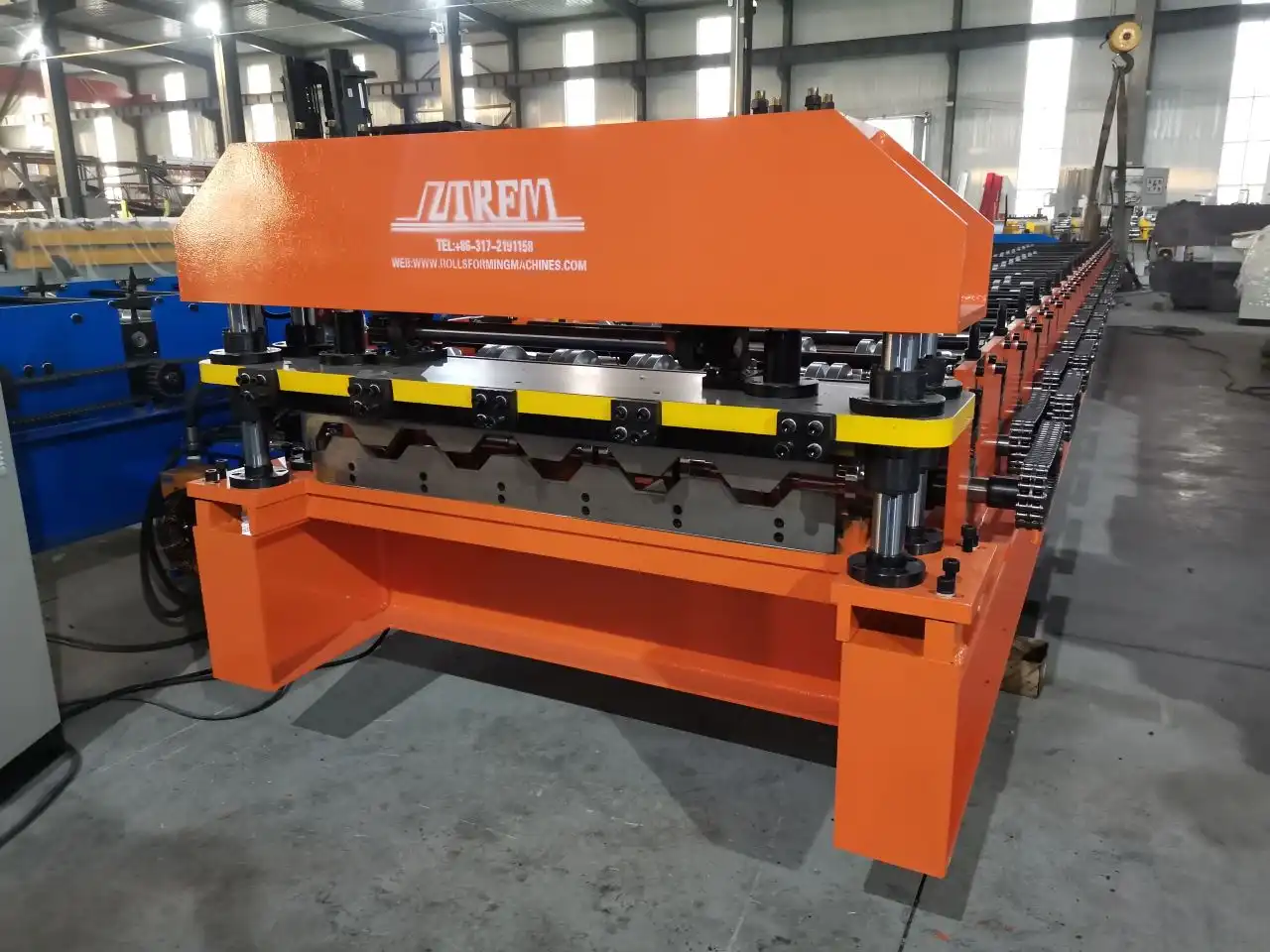
Most lines begin with a decoiler, which holds the coil. The strip goes through an entry guide, the forming stations, and a cutting section that is controlled by a PLC. It then ends up on a run-out table or stacker. There are 26 roller stations on our trapezoidal sheet roll forming machine, so the profile grows in small steps. The PLC lets you set the length, and the hydraulic cutter cuts each sheet to size. This setup is used to make the same panel every day by people who make roofs, barns, and prefab homes.
Who Usually Benefits Most
Roll forming works well for companies that sell a few profiles every week, like those that make roofing sheets, steel service centers that want to make panels, contractors who want to supply their own work, and prefab builders. In the US, PBR and R-panel are the most common types of exposed-fastener roofing, so most buyers only use one or two profiles. Press brakes work better for shops that make trim, brackets, and one-of-a-kind parts. If you sell both, a hybrid setup might work better.
Performance and Profile Flexibility Compared
Speed, Repeatability, and Labor
Our rapid model cuts and shapes at ±1 mm per minute and goes from 0 to 60 m per minute. You can't get that speed with a press brake on lengthy panels since each rib has to be bent and put in place individually, and the bed length restricts the sheet size. Handling is also reduced with roll forming since one man fills the coil, adjusts the length, and takes off the stacked sheets. Don’t compare catalog pace but completed panels per shift. Since actual output varies with variations in coils, panel length, thickness, and rib depth, request a test with your own material.
Profile Flexibility and Tooling
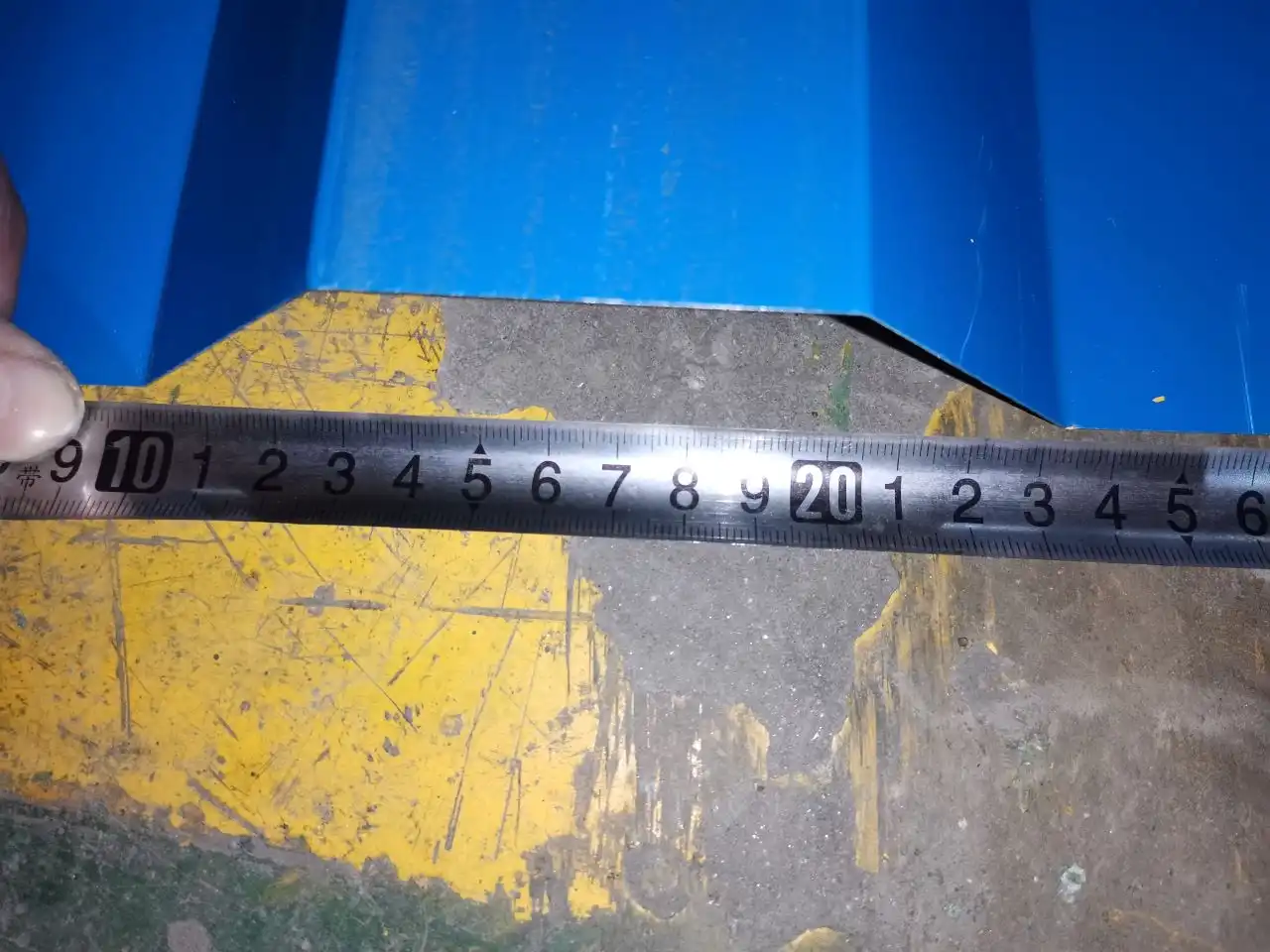
Press brakes are ideal for prototypes and items that aren't quite perfect because a die or program update affects the form. Roll forming is not a rigorous process, however, and a roller set is built for a certain shape. We manufacture bespoke trapezoidal profiles to a CAD model or sample panel. We may also vary the range of materials, the breadth of the trapezoidal sheet roll forming machine, and the number of roller stations. Also, our manufacturing features quick-change cassette tooling for companies that produce a lot of varied forms. For both trapezoidal and corrugated profiles, you need to know the cover width, rib height, rib spacing, and side lap design before ordering the proper rollers.
Surface Quality and Material Compatibility
Pre-painted steel is easily scratched; thus, the manner in which it is manufactured is critical. In roll forming, the bend is distributed across multiple stations. Our rollers are produced from 45# steel and hard chrome coated for smoothness and wear resistance. The equipment can process coils of PPGI, GI, and aluminum from 0.3mm to 1mm. This range includes steel gauges such as 24 and 22 and 0.032-inch aluminum. Different paint systems can react differently to flexing, so conduct a test run to be sure the coating will function.
Specifications of the ZTRFM High-Speed Trapezoidal Roll Former
Core Technical Data
These are the specifications we got from the manufacturer for our high-speed variant. The thicknesses may vary from 0.3 mm to 1 mm, and the widths can be 1000 mm or 1250 mm. The line has 26 roller stations with solid shafts of 80 mm. The primary motor is 5.5 kW, the hydraulic station is 7.5 kW, and the steel frame is 350 H. Control is done using PLCs. Standard 3-phase 380 V, 50 Hz electricity. We can alter the voltage. So tell us how your plant receives its electricity. Your profile also adjusts the number of stations and the breadth.
Cutting Quality and Stability
The hydraulic cutting system is equipped with Cr12MoV blades, which generate burr-free edges and edges that are ±1 mm from the target size. A gearbox transmission allows the drive to remain smooth and eliminates vibration, so the quality remains the same during lengthy runs. The cast iron parts and structure are excellent quality, suited for continuous production with low maintenance. We provide bespoke panel lengths up to 20 feet 10 inches and lengthy flashings up to 20 feet 11 inches. Plan your stacking and run-out space by the length of your longest panel.
Applications and Factory Support
The panels may be used as roofing and as vertical or horizontal wall cladding for warehouses, agricultural barns, workshops, low-rise commercial structures, and prefab residences. ZTRFM was founded in 2014 in Botou, Cangzhou, which is the largest roll forming machine base in China. Our goods are marked with ISO 9001, CE, and CAS, and are utilized in over 150 countries. Many models come with a complimentary manual decoiler. We provide remote diagnostics via the Siemens cloud IoT and a video of your very own coil in a trial run before shipping. OEM buyers may include tooling drawings in the NDA they sign.

Cost and Selection
Total Cost of Ownership
A press brake might be cheaper for a firm that handles a lot of various tasks. A roll forming line will often have a cheaper cost per panel for the same volume. This is because the cost of labor, scrap, and handling per sheet is reduced. The price depends on the kind of profile, the number of stations, the capacity of the decoiler, the cutting process, the stacking, and electrical standards. Record for each shift the number of hours worked, materials lost, energy utilized, tools, repairs, downtime, and output. Look at each quotation for what it covers, i.e., quantity of decoilers, spare roller sets. If you can't acquire the frame, rollers or replacement parts, then a low price means nothing.
A Simple Selection Process
Begin with a manufacturing brief that comprises a profile drawing, material and thickness, coil width, panel lengths, estimated output, floor space and power supply. Then rate each technique on profile fit, capacity, accuracy, changeover time, manpower, and servicing access. If you are making one to three profiles at a medium to large volume, then roll forming is superior in most respects. For short, curved sections, a press brake is perfect. This grading means the decision is based on what you really do, not what you say you do.
When a Hybrid Setup Makes Sense
Many roofing contractors utilize both types of trapezoidal sheet roll forming machines. Most of the sheets for the trapezoidal or PBR design are manufactured on the roll former. The press brake, however, creates ridge tops, drip edges, and bespoke trim for every task. Separating the two allows the roll former to maintain running the same volume of parts, while the press brake can handle one-off orders. “Before you invest, find out how many of your sales are from standard panels and how many are from custom parts. That ratio informs you which machine should be given the greater budget initially.

Supplier Checks and Common Mistakes
What to Verify in a Supplier
Make sure that the firm you are working with is a manufacturer, an integrator, or a trade organization. Ask about certifications like ISO 9001, CE, factory inspections, customer references, warranty terms, availability of replacement parts, packing techniques, and technical help you can receive from afar. They normally want to see a video approval test before they can ship anything to a customer in the U.S. Match me with your own coil. This is the moment to fill in Incoterms, payment milestones, lead time, and acceptance conditions before the deposit transfers.
Mistakes to Avoid
Most individuals make errors such as choosing the cheapest quotation, trusting the catalog speed, buying rollers before signing off on the final plan, and not paying attention to the floor arrangement. Small modifications in the breadth of the cover, the geometry of the side-lap, or the distance between ribs might alter tooling design and the way panels are laid out on site. Order tests that match the length, thickness, and coil of the ones you have. Then don’t compare it to the quickest speed on a spec sheet; compare it to the output your company strategy demands.
Plan the Plant Before Delivery
Crane access should be safe before machine arrival, storage for coils, handling of completed panels, area for maintenance, safe paths for personnel. Safety is a big issue in U.S. companies and work sites, so discuss guarding and layout with your supplier early. Also check the power supply. Our voltage is 380 V, 50 Hz, three-phase; however, we may adjust it if you want. When requesting a price, inform us of your plant’s voltage and frequency to minimize delays during commissioning.
Conclusion
Press braking and roll shaping are two alternative techniques to tackle difficulties. The trapezoidal sheet roll forming machine transforms coil into long reproducible panels in a single step. If the volume and profiles remain the same, this saves time and money on each panel. Since a press brake bends one line at a time, it’s suitable for flashings, prototypes, and short items. The decision should not be based just on pricing; profile geometry, material thickness, length of panel, estimated production, and total cost of ownership should also be considered. You may reduce risk by testing your own coil and ensuring that acceptance criteria are clearly defined. Many roofing businesses utilize the two machines simultaneously.
FAQ
1. Is roll forming faster than press braking for roofing panels?
Yes, for long sheets that repeat. Our fast machine can shape at up to 60 meters per minute and cut with a tolerance of ±1 mm. When you need to change parts or make small batches, a press brake is better.
2. Can one roll former make several trapezoidal profiles?
Every machine is made to work with a single profile. You can choose from multi-profile options, like quick-change cassette tooling. Just send us your drawings, and our engineers will let you know if it's possible.
3. What should I send for a quotation?
Send an outline drawing or a sample panel, along with the type of material, thickness, coil width, panel length, monthly output goal, voltage and frequency, and cutting preference. We can quickly suggest the right configuration when we have all the data we need.
Request a Quote from ZTRFM
ZTRFM makes trapezoidal sheet roll forming machines. They have ISO 9001, CE, and CAS certifications, and their machines are used in more than 150 countries with OEM and ODM tools. Send your profile drawing, material, and output target to zhongtuorollforming@gmail.com. Our engineers will then suggest a configuration and set up a video of a test run.
References
1. Roll Forming Handbook, 2005
2. Manufacturing Engineering and Technology, 2013
3. North American Specification for the Design of Cold-Formed Steel Structural Members (AISI S100), 2016
4. ASTM A653/A653M Standard Specification for Steel Sheet, Zinc-Coated (Galvanized) or Zinc-Iron Alloy-Coated (Galvannealed) by the Hot-Dip Process, 2020
5. Fundamentals of Modern Manufacturing, 2019
6. Metal Forming: Mechanics and Metallurgy, 2011